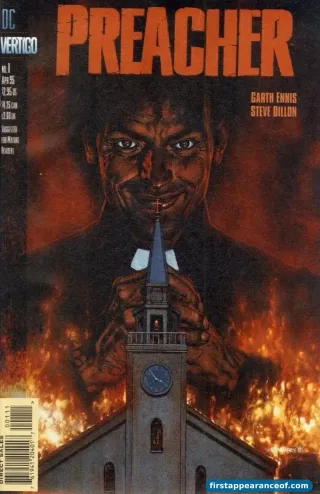
Preacher #1 (1995). Vertigo. Garth Ennis and Steve Dillon's debut. Glenn Fabry cover.

1st Appearance and 1st Cover

First Appearance of Jesse Custer

Preacher #1

April 1995 · DC · Modern Age

Garth Ennis and Steve Dillon's Vertigo masterpiece. The small-town Texas preacher with the Word of God in his throat, two ride-or-die companions, and a crisis-of-faith arc that ran 66 issues.

Key Issue

Created by Garth Ennis · Steve Dillon

By Atomm Updated

The first appearance (1st app) of Jesse Custer is Preacher #1 (April 1995), created by Garth Ennis (writer) and Steve Dillon (artist). The issue is both his first appearance and first cover. Tulip O'Hare and Cassidy also debut in the same issue. Glenn Fabry painted the iconic cover. Preacher ran 66 issues plus several specials through 2000 and is widely regarded as one of the strongest Vertigo titles ever published. The 2016 AMC television adaptation reset the character's cultural visibility at scale.

Quick Facts

Debut
Preacher #1 (April 1995)
Real name
Jesse Custer
Creators
Garth Ennis (writer, co-creator), Steve Dillon (artist, co-creator), Glenn Fabry (cover art)
Publisher
DC Comics (Vertigo imprint)
First enemy
The Saint of Killers (debuts in Preacher #2, becomes the series's recurring antagonist alongside the broader institutional Catholic Church conspiracy)
First ally
Tulip O'Hare (his partner), Cassidy (the Irish vampire) — both debut in Preacher #1
Team affiliations
None. Jesse, Tulip, and Cassidy are themselves the unit.

First Appearance

  1. Preacher #1 cover
    First Appearance First Cover April 1995

    Preacher #1

    By Garth Ennis, Steve Dillon, Glenn Fabry

    Garth Ennis writes; Steve Dillon pencils; Glenn Fabry covers. Jesse Custer, Tulip O'Hare, and Cassidy all debut in the issue. The book is one of Vertigo's most-celebrated launches and one of the most influential indie creator-owned works of the 1990s. Genesis (the celestial entity that bonds with Jesse and gives him the Word of God) is also introduced.

    Read the full breakdown

Creation Story

Jesse Custer is Garth Ennis and Steve Dillon’s Vertigo masterpiece. Preacher #1 (April 1995) introduces three central characters in a single issue: Jesse Custer, a small-town Texas preacher having a crisis of faith; Tulip O’Hare, his ex-girlfriend who has become a contract assassin; and Cassidy, an Irish vampire who has been living in America for decades. The issue’s opening sequence has the celestial entity Genesis (a forbidden child of an angel and a demon, hidden by a faction of heaven, hunted by both sides) bond with Jesse and give him the power of the Word of God.

Garth Ennis writes; Steve Dillon pencils; Glenn Fabry provides the painted cover. The Fabry covers became one of the most-collected Vertigo cover-art series. Dillon’s interior art (clean line work, careful character acting, deliberate page composition) became the visual foundation that the AMC adaptation later drew from in its production design.

The book’s tonal register is distinctive: Western-coded American iconography, theological-philosophical commentary, brutally direct profanity, recurring extreme violence as moral instrument, and a willingness to commit to character relationships across the series’s full arc. The Ennis-Dillon collaboration is widely regarded as one of the most successful sustained writer-artist partnerships in Vertigo history.

The 66-issue arc

Preacher ran 66 issues plus several specials and a one-shot through October 2000. The arc was planned. Ennis and Dillon mapped the conclusion from early in the run, and the series ended in a deliberate way that is rare for indie creator-owned ongoings of the era. The narrative tracks Jesse, Tulip, and Cassidy across America hunting God (literally; God has abandoned heaven and is hiding) while pursued by the Saint of Killers (the series’s recurring antagonist, debuting in Preacher #2) and the broader institutional conspiracy of the Grail (the Catholic Church’s secret political faction).

Preacher Special: Saint of Killers #1 (August 1996) by Garth Ennis and Steve Pugh tells the Saint’s full Western-supernatural origin. Widely regarded as one of the best Preacher tie-ins.

The AMC era

Preacher (AMC, 2016 to 2019) developed by Sam Catlin, Seth Rogen, and Evan Goldberg adapted the comics across four seasons. Dominic Cooper’s Jesse is widely regarded as a faithful tonal portrayal; the show restructured plot elements for the season-length television format but preserved the central character framework. The AMC adaptation reset the character’s cultural visibility at scale.

Collector context

Preacher #1 is the Jesse Custer Vertigo first-appearance key. High-grade CGC 9.8 copies have crossed $400 at auction. The book’s value accelerated with the 2016 AMC adaptation and has held.

Secondary keys: Preacher #2 (1995, first Saint of Killers). Preacher Special: Saint of Killers #1 (1996, Saint origin). Preacher #66 (2000, series finale). The Glenn Fabry cover-art Vertigo paintings carry additional collector framing as a complete cover series.
Key subsequent appearances

After the debut, these are the issues collectors and historians reach for next.

  1. 1995

    Preacher #1

    First appearance and first cover.

  2. 1995

    Preacher #2

    First Saint of Killers

    Garth Ennis and Steve Dillon. First appearance of the Saint of Killers, the series's recurring antagonist.

  3. 1996

    Preacher Special: Saint of Killers #1

    Saint of Killers Origin

    Garth Ennis writes; Steve Pugh pencils. The Saint of Killers's full Western-supernatural origin. Widely regarded as one of the best Preacher tie-ins.

  4. 2000

    Preacher #66

    Series Finale

    Garth Ennis and Steve Dillon. Final issue of the 66-issue main run. The series concludes in a deliberate, planned way (rare for indie creator-owned ongoings of the era).

In adaptations

Film, TV, animation, and game appearances.

  1. 2016

    Preacher

    TV

    Starring:Dominic Cooper

    AMC series. Sam Catlin, Seth Rogen, and Evan Goldberg developed. Cooper plays Jesse across four seasons (2016 to 2019). Widely regarded as a faithful tonal adaptation; some plot elements were restructured for television but the character's framework is preserved.

Frequently asked questions

The questions readers and collectors ask most.

What is Jesse Custer's first appearance?

Jesse Custer's first appearance is Preacher #1 (April 1995), created by Garth Ennis (writer) and Steve Dillon (artist). The issue is both his first appearance and first cover. Glenn Fabry provided the painted cover. Tulip O'Hare and Cassidy also debut in the same issue, making Preacher #1 a triple-debut book for the series's three central protagonists.

Is Preacher #1 valuable?

Yes. Preacher #1 is a Vertigo key with strong adaptation-driven collector demand. High-grade copies (CGC 9.8) have crossed $400 at auction. The book's value accelerated with the AMC television series (2016 to 2019) and has held. Variant covers and the rare second-print copies carry additional collector premiums.

What is the Word of God?

Jesse's defining ability. The celestial entity Genesis (a forbidden child of an angel and a demon) bonds with Jesse in the series's opening sequence and gives him a power called Genesis: when Jesse speaks in command form, the listener is compelled to obey literally and absolutely. The Word is the series's central plot device; its consequences (theological, ethical, and immediately practical) drive most of Garth Ennis's 66-issue arc.

What is the Saint of Killers?

Preacher's recurring antagonist. The Saint is a Civil War-era cowboy whose family was killed by bandits, who pursued his vengeance to literal hell, and was given the role of Death's replacement when the original Death proved insufficient. He carries pistols of star-metal that never miss. He pursues Jesse for most of the series. The Saint of Killers debuts in Preacher #2 (May 1995) and gets his full origin in Preacher Special: Saint of Killers #1 (August 1996), drawn by Steve Pugh.

Did Preacher have a planned ending?

Yes. Garth Ennis and Steve Dillon planned the 66-issue arc deliberately, with the series's conclusion mapped from early in the run. The final issue (Preacher #66, October 2000) resolves all major narrative threads and is widely regarded as one of the better-planned creator-owned endings in Vertigo's history. Many indie ongoings of the era ended abruptly when commercial conditions changed; Preacher reached its planned conclusion intact, which is one of the reasons the run is held in such high regard.