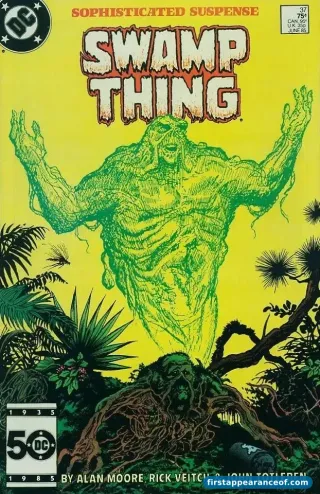
The Saga of the Swamp Thing #37 (1985). John Constantine on the cover, his first full appearance.

1st Full Appearance and 1st Cover

First Appearance of John Constantine

The Saga of the Swamp Thing #37

June 1985 · DC · Copper Age

Alan Moore's trenchcoat-wearing occultist, modeled on Sting. The Hellblazer who spent thirty years of Vertigo titles outsmarting demons and failing to outrun his own conscience.

Key Issue

Created by Alan Moore · Stephen Bissette · John Totleben

By Atomm Updated

The first appearance (1st app) of John Constantine is The Saga of the Swamp Thing #37 (June 1985), created by Alan Moore with art by Stephen Bissette and John Totleben. A preceding cameo appears in The Saga of the Swamp Thing #25 (June 1984) as an unnamed silhouetted figure. Constantine was designed after Sting's visual appearance in the early 1980s. His first solo title is Hellblazer #1 (January 1988), which ran 300 issues through 2013 under the Vertigo imprint. The character has been adapted for film (Keanu Reeves, 2005) and television (Matt Ryan, 2014 forward).

Quick Facts

Debut
The Saga of the Swamp Thing #37 (June 1985). Cameo in #25 (June 1984).
Real name
John Constantine
Creators
Alan Moore (concept, script), Stephen Bissette and John Totleben (art and character design based on Moore's description of Sting)
Publisher
DC Comics (Vertigo imprint, from Vertigo's 1993 launch forward)
First enemy
The Brujeria (occult antagonists in the American Gothic arc)
First ally
Swamp Thing (his initial connection)
Team affiliations
None formal long-term. Trenchcoat Brigade (loose alliance), Justice League Dark (post-2011 New 52)

Firsts Timeline

  1. First Cameo June 1984

    The Saga of the Swamp Thing #25

    By Alan Moore, Stephen Bissette, John Totleben

    Single-panel silhouette appearance in the final pages of Alan Moore's third Swamp Thing issue. Stephen Bissette and John Totleben on art. The figure is unnamed; Moore and the art team introduced Constantine as a background figure they would build out over subsequent issues.

    Read the full breakdown
  2. The Saga of the Swamp Thing #37 cover
    First Full Appearance First Cover June 1985

    The Saga of the Swamp Thing #37

    By Alan Moore, Stephen Bissette, John Totleben

    Constantine's first full appearance, first named appearance, and first cover. Alan Moore writes; Stephen Bissette and John Totleben on art. The issue is the beginning of Moore's American Gothic arc, which uses Constantine as Swamp Thing's occult guide.

    Read the full breakdown
  3. First Solo Title January 1988

    Hellblazer #1

    By Jamie Delano, John Ridgway

    Jamie Delano writes; John Ridgway pencils the first Hellblazer ongoing. The book ran 300 issues through 2013, one of the longest continuous Vertigo runs in the imprint's history.

    Read the full breakdown

Creation Story

John Constantine is Alan Moore’s design for a British working-class occultist who could operate within DC’s supernatural framework without being a superhero. Moore had been writing The Saga of the Swamp Thing since 1984 and was looking for a recurring occult-adjacent supporting character for the American Gothic arc he was building toward. Stephen Bissette and John Totleben designed the visual character at Moore’s request: a blonde English man in a trenchcoat, deliberately modeled after Sting, the English musician who was at peak visibility in the mid-1980s.

The Saga of the Swamp Thing #25 (June 1984) contains Constantine’s first cameo: an unnamed silhouetted figure in the final pages, barely visible, introduced as a character the reader would learn about later. The character appears in the background of several subsequent issues before being named and given full visual treatment in The Saga of the Swamp Thing #37 (June 1985). Moore’s American Gothic arc (issues #37 through #50) uses Constantine as Swamp Thing’s occult guide, introducing him as a working-class Liverpool-born magician with dangerous competence and a habit of getting the people around him killed.

The character was popular enough that DC commissioned a solo title. Hellblazer #1 (January 1988) launched under the new mature-readers framework that would become Vertigo in 1993. Jamie Delano wrote; John Ridgway pencilled the first issue. Hellblazer ran 300 issues through 2013, one of the longest continuous runs in Vertigo’s history.

The Ennis era

Garth Ennis took over Hellblazer with issue #41 (May 1991) and wrote through issue #83 (November 1994). His run is widely regarded as the definitive Hellblazer era. The “Dangerous Habits” arc (Hellblazer #41 to #46) is the most-cited Constantine story: Constantine is dying of lung cancer and tricks the three Lords of Hell (Lucifer, Beelzebub, Azazel) into curing him by forcing them to recognize that civil war for his soul would follow if he died. The arc established the character’s defining trick-the-devil framework.

Subsequent Hellblazer writers (Paul Jenkins, Warren Ellis, Brian Azzarello, Mike Carey, Andy Diggle, Peter Milligan, Peter Tomasi) each brought distinct takes to the character across the 1990s and 2000s. The book’s consistent tone across decades is unusual in mainstream comics.

The adaptations

Constantine (2005) with Keanu Reeves Americanized the character but has developed a cult following. Reeves is confirmed to return in a 2026 sequel.

Matt Ryan’s Constantine (NBC, 2014) is widely regarded as the most faithful screen performance. The show was cancelled after one season, but Ryan continued the role across Arrow, Legends of Tomorrow, multiple DC animated films, and the 2024 Constantine: The House of Mystery animated series.

Collector context

The Saga of the Swamp Thing #37 is the Constantine Copper Age key. High-grade CGC 9.8 copies have crossed $1,500 at auction. The book’s value moved with each major adaptation.

Secondary keys: The Saga of the Swamp Thing #25 (cameo) is a cheaper entry for collectors targeting the technical first. Hellblazer #1 (1988) is the first solo title and a collector target for Vertigo-imprint collectors specifically. Hellblazer #41 (1991) starts the Ennis run and is an era-starting key.
Key subsequent appearances

After the debut, these are the issues collectors and historians reach for next.

  1. 1984

    The Saga of the Swamp Thing #25

    First cameo. Unnamed silhouette.

  2. 1985

    The Saga of the Swamp Thing #37

    First full appearance and first cover.

  3. 1988

    Hellblazer #1

    First solo title.

  4. 1991

    Hellblazer #41

    Ennis Era

    Garth Ennis takes over Hellblazer writing. His twenty-plus-issue run is widely regarded as the definitive Hellblazer era, including the 'Dangerous Habits' arc where Constantine deceives the three Lords of Hell to cure his lung cancer.

  5. 2011

    Justice League Dark #1

    New 52 Team

    Peter Milligan writes. Constantine joins the Justice League Dark team under DC's main continuity after the New 52 reboot absorbed Hellblazer into the mainline.

In adaptations

Film, TV, animation, and game appearances.

  1. 2005

    Constantine

    Film

    Starring:Keanu Reeves

    Francis Lawrence directs. Reeves as an Americanized John Constantine. Mixed critical reception but has cult status. Reeves has been confirmed for a 2026 sequel.

  2. 2014

    Constantine

    TV

    Starring:Matt Ryan

    NBC live-action series. Ryan's performance is widely regarded as the most faithful screen Constantine. One season. Ryan continued the role in Arrow, Legends of Tomorrow, and the Constantine animated series.

  3. 2024

    Constantine: The House of Mystery

    Animated

    Starring:Matt Ryan

    DC animated series. Ryan continues as the voice of Constantine in DC animated features.

Frequently asked questions

The questions readers and collectors ask most.

What is John Constantine's first appearance?

John Constantine's first cameo is The Saga of the Swamp Thing #25 (June 1984) as an unnamed silhouetted figure. His first full appearance, first cover, and first named appearance is The Saga of the Swamp Thing #37 (June 1985). Both are by Alan Moore with art by Stephen Bissette and John Totleben.

Is Saga of the Swamp Thing #37 valuable?

Yes. The Saga of the Swamp Thing #37 is a Copper Age key and one of the most important Vertigo-precursor books. High-grade copies (CGC 9.8) have crossed $1,500 at auction. The book's value accelerated with the 2005 Keanu Reeves film and has held through the subsequent Matt Ryan TV performances.

Who is Constantine based on?

Sting. Alan Moore has stated that Stephen Bissette and John Totleben designed Constantine to look like Sting, the English singer, who was at peak visibility in the mid-1980s. Moore wanted a British working-class occult figure who would contrast with American superhero conventions; the Sting visual gave the character a specific real-world cultural anchor. The design has been modified across decades but the blonde-haired, trenchcoat-wearing silhouette remains the foundation.

What is Hellblazer?

Hellblazer is John Constantine's ongoing solo series, which ran 300 issues from January 1988 through March 2013 under the Vertigo imprint. It is one of the longest continuous creator-driven comics runs in American comics, spanning writers including Jamie Delano, Garth Ennis, Paul Jenkins, Warren Ellis, Brian Azzarello, Mike Carey, Andy Diggle, Peter Milligan, and Peter Tomasi. The series ended when Vertigo was reorganized and Constantine was absorbed into DC's main continuity via Justice League Dark.

Why can't Constantine die?

He can, and has. Constantine has been killed or brought to the brink of death in multiple Hellblazer arcs, most famously in Garth Ennis's 'Dangerous Habits' (Hellblazer #41 to #46, 1991), where Constantine tricks the three Lords of Hell into curing his terminal lung cancer by forcing them to recognize that his death would trigger a civil war for his soul. The character's longevity across thirty-plus years of publication is a function of his wit, not his invulnerability.