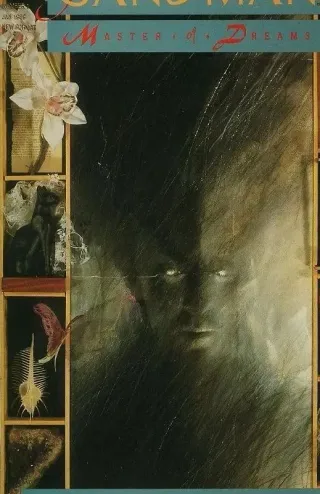
The Sandman #1 (1989). Morpheus on the cover by Dave McKean.

1st Appearance and 1st Cover

First Appearance of Dream

The Sandman #1

January 1989 · DC · Modern Age

Neil Gaiman's anthropomorphic Dream. One of the Endless, older than gods, and the central figure of the most critically acclaimed comic of the 1990s.

Key Issue

Created by Neil Gaiman · Sam Kieth · Mike Dringenberg · Malcolm Jones III

By Atomm Updated

The first appearance (1st app) of Dream of the Endless is The Sandman #1 (January 1989), created by Neil Gaiman with art by Sam Kieth, Mike Dringenberg, and Malcolm Jones III, and cover art by Dave McKean. The issue launches the character, his Endless siblings, and the mature-readers DC line that would formalize as the Vertigo imprint in 1993. Gaiman's 75-issue Sandman run (1989 to 1996) is one of the most critically acclaimed comics of the modern era. Dream has been adapted for television by Netflix in 2022 with Tom Sturridge in the title role.

Quick Facts

Debut
The Sandman #1 (January 1989)
Real name
Dream (his name and his function are identical)
Creators
Neil Gaiman (creator and writer), Sam Kieth (debut pencils), Mike Dringenberg (debut inks, later pencils), Dave McKean (cover art for the entire 75-issue run)
Publisher
DC Comics (pre-Vertigo, though the book became the imprint's flagship when Vertigo launched in 1993)
First enemy
Roderick Burgess (the occultist who imprisons him in the debut), Corinthian (his escaped nightmare)
First ally
Death (his older sister), Destiny, Desire, Despair, Delirium, Destruction (his Endless siblings)
Team affiliations
The Endless

First Appearance

  1. The Sandman #1 cover
    First Appearance First Cover January 1989

    The Sandman #1

    By Neil Gaiman, Sam Kieth, Mike Dringenberg, Malcolm Jones III

    Neil Gaiman writes; Sam Kieth pencils the debut with Mike Dringenberg inks and Malcolm Jones III inks. Dave McKean covers. The issue launches DC's Vertigo-adjacent mature-readers line a few years before the Vertigo imprint formally existed.

    Read the full breakdown

Creation Story

Dream is Neil Gaiman’s creation. In 1988, DC asked Gaiman (then a British comics writer with growing reputation through Black Orchid) to revive a lapsed DC trademark: the Sandman name, which the company had used across multiple unrelated characters since the 1940s. Gaiman agreed to the assignment but pitched a complete reimagining: rather than continuing any prior Sandman character, he would create a new Dream figure, one of seven anthropomorphic Endless siblings who embody universal concepts older than gods.

The Sandman #1 (January 1989) introduces Dream in captivity. Roderick Burgess, an English occultist, has imprisoned him in a magical circle for seventy-two years, attempting to capture Death but catching her brother instead. The book opens with Dream’s 1916 imprisonment and escape decades later. Sam Kieth pencilled the debut; Mike Dringenberg inked and took over pencils from issue #5; Malcolm Jones III inked; Dave McKean designed covers for the entire 75-issue run.

Gaiman wrote all 75 issues (January 1989 to March 1996) across seven years. The book was published at DC before the Vertigo imprint formally launched in 1993; Sandman became Vertigo’s flagship title at launch and anchored the imprint’s critical reputation for its entire existence.

The Endless

Gaiman’s signature contribution to comics is the Endless mythology. Seven siblings who are not gods but older than gods, each the personification of a universal concept:

The Sandman #8 (August 1989), “The Sound of Her Wings,” introduces Death and is widely regarded as one of the best single issues ever published in American comics. Death became popular enough to anchor her own spin-off limited series and a graphic novel.

The Lucifer connection

The Sandman #4 (April 1989) introduces Lucifer Morningstar as the Sandman-continuity Lucifer. The character appears throughout Gaiman’s run, most centrally in the Season of Mists arc (issues #21 to #28, 1990 to 1991) when Lucifer abdicates Hell. Lucifer later became the subject of Mike Carey’s Lucifer series (2000 to 2006) and the 2016-2021 Fox/Netflix TV adaptation.

The Netflix era

The Sandman (2022) on Netflix, developed by Neil Gaiman with Allan Heinberg, adapted the first several arcs of the comics with Tom Sturridge as Dream. The series was widely praised for fidelity to source material and has run two seasons. The adaptation reset the character’s cultural visibility at scale and drove substantial new collector interest in Sandman first-print issues.

Collector context

The Sandman #1 is the Dream Modern Age key. High-grade CGC 9.8 copies have crossed $500 at auction. Newsstand variants carry a meaningful premium. The book’s value accelerated substantially with the 2022 Netflix series.

Secondary keys: The Sandman #8 (first Death, “The Sound of Her Wings”) is a collector-favorite in its own right. The Sandman #4 (first Lucifer) is a related key. The Sandman #21 (Season of Mists begins) is an arc-starter key.
Key subsequent appearances

After the debut, these are the issues collectors and historians reach for next.

  1. 1989

    The Sandman #1

    First appearance. Roderick Burgess imprisons Dream for decades.

  2. 1989

    The Sandman #4

    First Lucifer

    First appearance of Lucifer Morningstar (Sandman-era Lucifer). Sets up the Season of Mists arc.

  3. 1989

    The Sandman #8

    First Death

    First appearance of Death of the Endless. 'The Sound of Her Wings.' One of the most celebrated single issues in American comics.

  4. 1990

    The Sandman #21

    Season of Mists

    Season of Mists arc begins. Lucifer abdicates Hell and hands Dream the key. Nine-issue arc through issue #29.

  5. 1995

    The Sandman #72

    The Kindly Ones Concludes

    Dream dies at the end of Gaiman's penultimate arc. Succeeded by a new Dream (Daniel).

  6. 1996

    The Sandman #75

    Final Issue

    Gaiman's Sandman run ends with issue #75. Seventy-five-issue run across seven years.

In adaptations

Film, TV, animation, and game appearances.

  1. 2020

    The Sandman (audio)

    Other

    Starring:James McAvoy

    Audible audio drama adaptation. McAvoy as Dream. Full-cast production including Riz Ahmed, Kat Dennings, Michael Sheen.

  2. 2022

    The Sandman

    TV

    Starring:Tom Sturridge

    Netflix series adaptation. Sturridge's Dream in the lead. Faithful to the comics in tone and structure. Two seasons.

Frequently asked questions

The questions readers and collectors ask most.

What is Dream's first appearance?

Dream's first appearance is The Sandman #1 (January 1989), created by Neil Gaiman with art by Sam Kieth, Mike Dringenberg, and Malcolm Jones III, and covers by Dave McKean. The issue is both his first appearance and first cover. The book launches at DC before the Vertigo imprint formally existed; Sandman became Vertigo's flagship title when the imprint launched in 1993.

Is The Sandman #1 valuable?

Yes. The Sandman #1 is a modern-era key and the most important Vertigo book ever published. High-grade copies (CGC 9.8) have crossed $500 at auction. Newsstand variants carry a meaningful premium. The book's value accelerated substantially with the 2022 Netflix series and has held since.

Is Dream the same as the Golden Age Sandman?

No. The Golden Age Sandman is Wesley Dodds, a gas-mask-wearing 1940s DC crimefighter (Adventure Comics #40, 1939). Neil Gaiman deliberately chose the Sandman name for his 1989 book because DC had the trademark available; he built Dream as an unrelated character. Gaiman's Dream is one of the Endless, anthropomorphic embodiments of universal concepts older than gods. Wesley Dodds does eventually appear in Gaiman's Sandman as a supporting character, but the two are distinct entities.

Who are the Endless?

The seven siblings who are Dream's family: Destiny (the eldest), Death, Dream, Destruction, Desire, Despair, and Delirium (the youngest). Each is the embodiment of a universal concept. The Endless predate gods and cannot die in the conventional sense; they can cease or be succeeded, which happens to Dream himself at the end of Gaiman's run. The Endless mythology is the defining original contribution of Sandman to comics.

Is The Sandman intended for mature readers?

Yes. The Sandman was published as a mature-readers title from its 1989 debut, before the Vertigo imprint formally existed. The book deals with explicitly adult themes (sexuality, violence, mortality, myth) in ways standard DC superhero books did not. The 2022 Netflix series preserves the adult tone with a TV-MA rating.

Has Dream died?

Yes, in The Sandman #72 (1995). At the end of The Kindly Ones arc, Gaiman kills Dream and the role is assumed by Daniel Hall, a former mortal. The succession is canonical; subsequent Sandman-universe stories have featured Daniel as the current Dream. Gaiman's 75-issue run remains the definitive Sandman story.

Related characters