Creation Story
Jack Kirby’s last Marvel run was a strange one. He’d come back from DC in 1975 on a contract that gave him broad creative latitude, and he used that latitude to put out work that was more personal and weirder than the company-line books he’d defined a decade earlier. The Eternals. Captain America. The 2001: A Space Odyssey adaptation. And in 1978, Devil Dinosaur, a book about a red T. rex and a primate-humanoid sidekick named Moon-Boy, set on a prehistoric Earth that Marvel would later designate Earth-78411.
The pitch had no spin to it. It was a dinosaur and a kid, the kid wasn’t even human, and the book wasn’t tied to anything else in the Marvel line. It ran nine issues from April to December 1978 and got cancelled before Kirby left Marvel for the last time. Most readers at the time treated it as a curio, the work of a creator who’d lost the audience. The book’s tonal register was kid-friendly in a way the broader Marvel line wasn’t, specific in the way Kirby’s Fourth World was specific, and entirely uninterested in fitting into the larger continuity. There was no team affiliation. No connection to other Marvel characters. The book was its own pocket of the universe and stayed that way for nearly four decades.
For roughly forty years, Devil and Moon-Boy showed up in odd corners. A Godzilla / S.H.I.E.L.D. crossover in 1979. Time-travel cameos through the 1980s and 90s. Pet Avengers in 2009. Always as a curiosity, never as a lead. By the early 2010s, Devil was the kind of character only deep-cut Marvel readers could place from memory.
Then 2015 happened. Brandon Montclare, Amy Reeder, and Natacha Bustos launched Moon Girl and Devil Dinosaur, and the conceit was that Devil wasn’t being remade or rebooted. He was being yanked through a dimensional rift, the literal Kirby dinosaur, into the present-day Marvel Universe. That decision is what gives the modern Devil his weight. Every appearance after 2015 is canonically the same red T. rex Kirby drew in 1978, just temporally displaced. The 47-issue run that followed treated him as a sidekick, a co-lead, and occasionally a heavy-hitter, and by the time the title ended in 2019 Devil was a permanent fixture of Earth-616.
The 2023 Disney+ animated series adapted that framework for a Saturday-morning audience. Fred Tatasciore voices Devil, though “voices” is generous: Devil grunts and growls and laughs in a way that reads as character-specific rather than generic dinosaur sound. The character design preserves the Kirby silhouette without copying his line work, which is harder than it sounds. The result is the largest cultural moment Devil has had in his entire publication history. Kids who’d never heard of Jack Kirby know what Devil Dinosaur looks like.
First Appearance, First Cover, First Solo Title: Devil Dinosaur #1
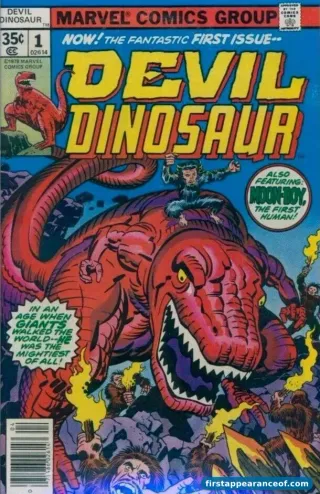
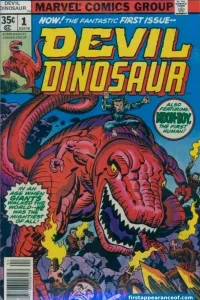
Devil Dinosaur #1 hit shelves in early 1978 with an April cover date. 32 pages, 35 cents. Kirby is solo on the credits: he plotted, scripted, pencilled, and oversaw the inks. Mike Royer handled the actual ink work. The cover is straight Kirby kinetics: a snarling red T. rex looming over Moon-Boy, who’s holding up a torch in a pose that looks frozen mid-leap.
The story opens on prehistoric Earth-78411. Moon-Boy, a young furred primate-humanoid, watches a tribe of “killer-folk” (early Neanderthal-coded antagonists) corner a young red Tyrannosaurus and try to burn it alive. Moon-Boy intervenes, saves the dinosaur, and the two bond on the spot. The dinosaur turns out to be permanently red because of the burn ordeal, and Moon-Boy names him Devil. The rest of the issue establishes the buddy-cop dynamic that carries the book: Moon-Boy is the brain, Devil is the apex predator, and together they protect their valley from everything that wants to eat or burn them.
For collectors, Devil Dinosaur #1 is a Bronze Age key with a specific niche profile. It’s a Kirby first-appearance book, his last all-new solo creation for Marvel, and one of the last issues in his second Marvel run. High-grade copies (CGC 9.6 and above) trade in the low-to-mid four-figure range. The print run was conservative because the book was a known commercial gamble at the time. Newsstand-distribution copies are abundant; the direct-market split that defines Copper Age and Modern Age collecting wasn’t a meaningful factor in 1978. The book’s value moves up with Devil-related cultural events more than with general Bronze Age market trends. The 2015 Moon Girl and Devil Dinosaur launch pushed it. The 2023 animated series pushed it again. Neither was a single dramatic price-spike event; both were gradual lifts.
What makes the original issue interesting beyond collecting is the pacing. The book is full of the dynamic-energy panels you’d recognize from any of Kirby’s late-period work. Devil charges. Moon-Boy ducks. The killer-folk scatter. Moon-Boy delivers exposition in dense thought-balloon prose, because Kirby was scripting himself in 1978 and his prose register was always denser than what other Marvel writers of the era produced. Reading Devil Dinosaur #1 today, the most striking thing is how unmistakably it’s Kirby and only Kirby. There’s no editorial smoothing. No house-style hedging. It’s the artist as auteur, working on a book Marvel didn’t quite know what to do with, in a year where most of the line had moved on from the kind of comics he wanted to make.
That’s part of why the book aged well. It’s not trying to be the Hulk. It’s not trying to be the Avengers. It’s trying to be a Kirby book about a red T. rex, and forty-eight years later that’s still a more specific creative statement than most of what shipped that month.
First Modern Appearance: Moon Girl and Devil Dinosaur #1
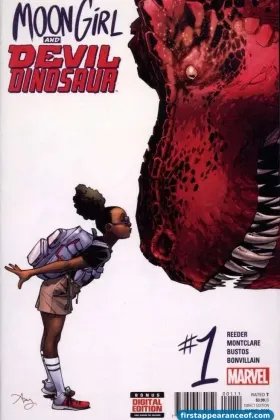
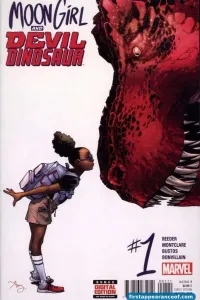
Moon Girl and Devil Dinosaur #1 is dated November 2015 and shipped in early October. Brandon Montclare and Amy Reeder write; Natacha Bustos pencils; Reeder draws the cover. Cover price 3.99. The cover is a near-square composition: Lunella Lafayette in goggles, hand outstretched, the red Tyrannosaurus looming behind her. The composition is deliberately not a fight scene. That choice tells the reader what the book is before they open it.
The issue belongs to Lunella for most of its 22 pages. She is nine years old, lives on the Lower East Side, attends P.S. 20, and is rebuilding a Kree omni-wave projector she pieced together from salvaged parts. The projector opens a dimensional rift and Devil comes through it from Earth-78411. He arrives with no caption, no exposition, no editorial smoothing of what he is. Bustos draws him at full Kirby scale, towering in an alley behind Lunella. The bond between the two characters does not lock in this issue (that takes the next several issues) but the working dynamic is set: she handles the brain, he handles the muscle, and neither needs to say a word for the partnership to function.
The framing decision is what makes the issue a key. Most legacy-character revivals try to update the design, modernize the voice, and quietly retire the original. Montclare and Reeder did the opposite. The Devil who steps out of the rift is the literal 1978 Kirby character, time-displaced, with no continuity revisions and no modernized look. That commitment is what makes every appearance after 2015 readable as a continuation of the Kirby run rather than a translation of it. It is also what makes Moon Girl and Devil Dinosaur #1 a Devil Dinosaur key as well as a Moon Girl debut: the issue is the first time canonical Earth-616 has the actual red T. rex Kirby drew on it, in active rotation.
The 47-issue run that followed treated Devil as a co-lead, established Lunella as a permanent Marvel character, and ended in 2019. The Disney+ animated series in 2023 adapted the pairing for a kids’ audience and ran two seasons. Diamond White voices Lunella; Fred Tatasciore voices Devil. The current Marvel publishing slate keeps Devil and Moon Girl in rotation as a unit. None of that line is possible without the framing decision in this 2015 issue.
Collector context
Two issues anchor the character: Devil Dinosaur #1 (April 1978) and Moon Girl and Devil Dinosaur #1 (November 2015). The 1978 book is the historical key, a Jack Kirby solo creation from the last lap of his Marvel career. The 2015 book is the continuity key, the issue that pulled Devil into Earth-616 and started the run that put him back into active rotation.
The next collector tier covers the issues already on this page’s Key subsequent appearances list: Devil Dinosaur #9 (the cancelled finale), Godzilla #21 (the first non-Kirby use of the character), Lockjaw and the Pet Avengers #1 (the first sustained ensemble role before the 2015 revival), and Moon Girl and Devil Dinosaur #1 itself as the modern continuity key.
What makes Devil Dinosaur’s collectible profile distinct from most Bronze Age Kirby keys is the gap between cultural relevance and book price. The character is in active rotation across animation, ongoing comics, and licensed product. The first appearance is still a 1978 Kirby solo book that trades in the low-to-mid four figures at high grade, accessible in mid-grade for collectors who want a Kirby creator-credited key without paying Eternals #1 or New Gods money. The 2023 animated series moved the price band but did not break it. The next move is whatever Marvel and Disney do with the character on screen, which is not predictable from the publication record alone.