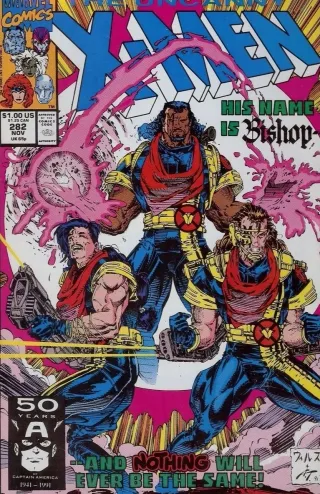
Uncanny X-Men #282 (1991). Bishop arrives from the future.

1st Cameo Appearance

First Appearance of Bishop

Uncanny X-Men #282

November 1991 · Marvel · Modern Age

Whilce Portacio's energy-absorbing time-traveling mutant cop. The 1991 future-arrived character whose power redirected through every major X-Men event.

Key Issue

Created by Whilce Portacio · John Byrne · Jim Lee

By Atomm Updated

The first appearance (1st app) of Bishop is Uncanny X-Men #282 (November 1991), where he debuts in a brief cameo at the end of the issue. His first full appearance is Uncanny X-Men #283 (December 1991), which establishes his mutant powers and X.S.E. (Xavier's Security Enforcers) backstory. Whilce Portacio is the story and pencils co-creator with John Byrne on script. Jim Lee provided the cover. Most collectors treat #282 as the first appearance and #283 as the first full and first cover.

Quick Facts

Debut
Uncanny X-Men #282 (November 1991, cameo); #283 (December 1991, full appearance)
Real name
Lucas Bishop
Creators
Whilce Portacio (story and pencils, co-creator), John Byrne (script, co-creator), Jim Lee (cover)
Publisher
Marvel Comics
First enemy
Trevor Fitzroy (his contemporary in the alternate-future timeline he traveled from)
First ally
Storm (his commanding officer when integrated with the X-Men)
Team affiliations
X-Men, X.S.E. (Xavier's Security Enforcers, future), Bishop's Brigade

Firsts Timeline

  1. Uncanny X-Men #282 cover
    First Cameo Appearance November 1991

    Uncanny X-Men #282

    By Whilce Portacio, John Byrne, Jim Lee

    Whilce Portacio (story and pencils); John Byrne (script); Jim Lee (cover). Bishop appears in a brief cameo at the end of the issue, arriving in the present day from a future timeline. The cameo positioning is structurally identical to most early-1990s Marvel future-character introductions.

    Read the full breakdown
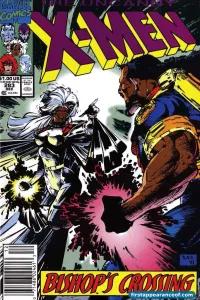
  2. Uncanny X-Men #283 cover
    First Full Appearance First Cover December 1991 Newsstand variant

    Uncanny X-Men #283

    By Whilce Portacio, John Byrne, Jim Lee

    First full Bishop appearance. Whilce Portacio writes and pencils; John Byrne scripts; Jim Lee provides the cover. Bishop's mutant ability (energy absorption and re-emission) is established. The X.S.E. (Xavier's Security Enforcers) backstory is introduced.

    Read the full breakdown

Creation Story

Bishop is a Whilce Portacio and John Byrne co-creation for the early-1990s Uncanny X-Men. Uncanny X-Men #282 (November 1991) introduces the character in a brief cameo at the end of the issue: an unfamiliar mutant arrives from a future timeline, says little, and exits the panel. Portacio handled the story and pencils; Byrne provided the script; Jim Lee drew the issue’s cover.

Uncanny X-Men #283 (December 1991) is the first full Bishop appearance. The issue establishes the character’s mutant ability (absorbing energy attacks and re-emitting them) and his X.S.E. (Xavier’s Security Enforcers) backstory. Bishop is from an alternate future where the X-Men were murdered in an extinction event and a paramilitary mutant police force was established in their absence; he served as a senior X.S.E. officer before being displaced into the present while pursuing a fugitive. The first-cover positioning on #283 made the issue collector-priority alongside the technical-first #282.

Uncanny X-Men #287 (April 1992) is Portacio’s full Bishop origin issue. The X.S.E.’s mythology, Bishop’s mentor relationship with Hancock, and the Witness prophecy framework are established. The issues form a tight three-part Bishop arc that introduced the character’s complete narrative framework within his first six months of publishing.

The X-Men core era

Bishop integrated with the X-Men under Storm’s leadership and became a regular team member through most of the 1990s. His energy-redirection power gave the team a hard-hitter that Wolverine and Colossus didn’t replicate. His authoritarian-cop personality and his future-knowledge framework (the Witness mythology, the eventual betrayal he believed was inevitable) gave him a dramatic trajectory that the standard X-team didn’t otherwise provide.

The 1992 X-Men: The Animated Series preserved the time-travel framework. Philip Akin’s voice performance is the definitive animated Bishop. The “Days of Future Past” episode was the show’s most ambitious adaptation of the Bishop-related future-mutant material.

The Messiah Complex heel turn

X-Men: Messiah Complex #1 (November 2007) reversed Bishop’s alignment. The crossover (written collectively by Ed Brubaker, Mike Carey, Peter David, Craig Kyle, and Christopher Yost) had Bishop turn against the X-Men to hunt Hope Summers, a mutant messiah child whom his future timeline blamed for the eventual mutant extinction. The arc ran through the Cable ongoing (2008) as Bishop pursued Cable and Hope across time. The heel turn was controversial among fans, but the resulting Cable / Bishop / Hope chase storyline gave Bishop the most extended dramatic arc he has had.

The Messiah Complex storyline ended with Bishop defeated and depowered. He has appeared sporadically across subsequent X-runs in rehabilitation arcs.

The film

Omar Sy’s Bishop in X-Men: Days of Future Past (2014, Bryan Singer) is the character’s most prominent live-action role. Sy’s Bishop is part of the dystopian-future X-Men cohort facing the Sentinels, and the film preserves his energy-absorption power while adapting the time-travel framework to the film series’s own continuity.

Collector context

Uncanny X-Men #282 is the Bishop cameo first-appearance key. High-grade CGC 9.8 copies have crossed $300 at auction.

Uncanny X-Men #283 is the first full and first cover. It trades at a similar tier and is often the higher-priority pick for pragmatic buyers because it establishes the powers, costume, and origin framework. Bishop-completionists own both.

Secondary keys: Uncanny X-Men #287 (1992, full X.S.E. origin). X-Men: Messiah Complex #1 (2007, heel turn).
Key subsequent appearances

After the debut, these are the issues collectors and historians reach for next.

  1. 1991

    Uncanny X-Men #282

    First cameo appearance.

  2. 1991

    Uncanny X-Men #283

    First full appearance and first cover.

    Newsstand variant
  3. 1992

    Uncanny X-Men #287

    X.S.E. Origin

    Whilce Portacio. Bishop's full origin from the alternate-future timeline. Establishes the X.S.E. and the Witness mythology.

    Newsstand variant
  4. 2007

    X-Men: Messiah Complex #1

    Heel Turn

    Ed Brubaker, Mike Carey, Peter David, Craig Kyle, Christopher Yost. Bishop becomes the antagonist of the Messiah Complex crossover, hunting the mutant messiah child Hope Summers. Setup for his Cable / Hope hunting arc that runs through Cable (2008) and beyond.

In adaptations

Film, TV, animation, and game appearances.

  1. 1992

    X-Men: The Animated Series

    Animated

    Starring:Philip Akin

    Fox Kids series. Akin voices Bishop across the show's run, including the 'Days of Future Past' episode where the time-travel framework is preserved.

  2. 2014

    X-Men: Days of Future Past

    Film

    Starring:Omar Sy

    Bryan Singer directs. Sy plays Bishop in the dystopian-future sequences. His role in the film established the comics-derived future-soldier framing for live action.

Frequently asked questions

The questions readers and collectors ask most.

What is Bishop's first appearance?

Bishop's first appearance is Uncanny X-Men #282 (November 1991), where he debuts in a brief cameo at the end of the issue. His first full appearance is Uncanny X-Men #283 (December 1991), which also serves as his first cover. Whilce Portacio created the character with John Byrne; Jim Lee provided the #283 cover.

Is Uncanny X-Men #282 valuable?

Yes. Uncanny X-Men #282 is a Modern Age X-Men key with strong recurring-character weight. High-grade copies (CGC 9.8) have crossed $300 at auction. The book has tracked with Bishop's screen visibility, particularly Omar Sy's portrayal in X-Men: Days of Future Past (2014).

Should I get #282 or #283?

Most collectors target Uncanny X-Men #283 (the first full appearance and first cover) at the same tier as #282 (the cameo). #283 is structurally the more important book in collector frameworks because it establishes Bishop's powers, costume, and X.S.E. backstory. #282 is the technical first appearance and a slightly more affordable companion key. Bishop-completionists own both; pragmatic buyers usually prioritize #283.

Why does Bishop come from the future?

Bishop arrives in the present day from an alternate-future timeline (originally framed as Earth-1191) where he served as a member of X.S.E. (Xavier's Security Enforcers), a paramilitary mutant police force established in the wake of an X-Men extinction event. His mission was to track and apprehend a fugitive temporal criminal; he ended up displaced into the present and joined the X-Men. The future-cop mythology is the Whilce Portacio framework that defined the character through his early years and was preserved in the X-Men: The Animated Series adaptation.

Why did Bishop become a villain?

X-Men: Messiah Complex (2007) had Bishop turn against the X-Men to hunt Hope Summers, a mutant messiah child whom Bishop's future timeline blamed for the eventual mutant extinction. The arc ran through the Cable ongoing (2008) as Bishop pursued Cable and Hope across time, and was resolved when Bishop was defeated and depowered. The heel turn was controversial among fans but gave the character one of his most extended dramatic arcs.