Creation Story
Bane is a deliberate editorial creation. Chuck Dixon, Doug Moench, and Graham Nolan designed the character in 1992 specifically to be the antagonist who would break Batman’s back in the upcoming Knightfall arc. DC editorial wanted a new villain (rather than promoting an existing rogue) to carry the weight of the year-long crossover; Dixon and Nolan were given the assignment of creating someone whose intellectual capacity would be plausible for the task and whose physical capability would justify the back-breaking.
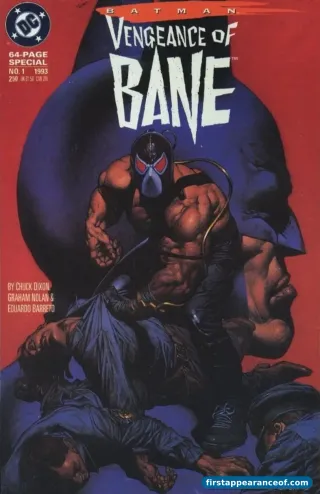
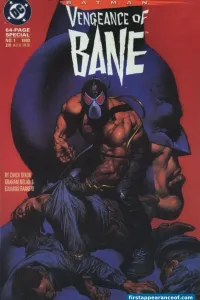
Batman: Vengeance of Bane #1 (January 1993) is the result. The forty-eight-page prestige-format one-shot establishes Bane’s origin: born to a revolutionary father in the fictional Caribbean nation of Santa Prisca, Bane is sentenced to serve his deceased father’s life sentence in Peña Duro prison from infancy. He spends his childhood and adolescence imprisoned, surviving by becoming the prison’s most lethal inmate. Government scientists experiment on him with the Venom super-soldier compound, which he survives. He escapes Peña Duro with three lieutenants (Trogg, Zombie, Bird) and arrives in Gotham with Batman as his target.
The debut issue makes Bane’s intellectual capacity unmistakable: he is a chess master, fluent in eight languages, has memorized military and historical strategy texts, and approaches Batman as a tactical problem to be analyzed and exhausted rather than overpowered.
Knightfall
Bane’s planning is the core of the Knightfall arc. Batman #491 (April 1993) opens the storyline with Bane releasing every inmate of Arkham Asylum to wear Batman down across weeks of city-wide combat. By the time Bane arrives at Wayne Manor for the personal confrontation, Bruce Wayne has been awake for days, bleeding, and physically depleted. Batman #497 (July 1993) is the climax: Bane breaks Bruce Wayne’s back over his knee. Doug Moench writes; Jim Aparo pencils. The single panel of the back-break is one of the most reproduced images in 1990s DC.
The Knightfall arc transitioned the Batman role to Jean-Paul Valley (Azrael) for a year of publishing time. Bruce Wayne’s eventual recovery and reclamation of the cowl was its own multi-arc storyline. The crossover sold heavily; Knightfall remains one of the most commercially successful Batman events of the modern era.
The Gail Simone reframing
Secret Six #1 (November 2008) by Gail Simone with art by Nicola Scott brought Bane onto Catman’s anti-hero team. Simone’s run developed Bane’s emotional complexity well beyond the Knightfall framing: his loyalty to Scandal Savage as a surrogate daughter figure, his philosophical commitments, and his evolving relationship to the Venom dependency. The Secret Six era is widely regarded as the strongest extended characterization Bane has received outside his original creators.
The Hardy era
Tom Hardy’s Bane in The Dark Knight Rises (2012, Christopher Nolan) restored the character’s intellectual framing after the substantial damage of Jeep Swenson’s Bane in Joel Schumacher’s Batman & Robin (1997). Hardy’s portrayal is widely regarded as the definitive screen Bane: imposing, articulate, ideologically motivated. The film’s commercial success drove first-print copies of Vengeance of Bane #1 sharply upward across collector markets.
Collector context
Batman: Vengeance of Bane #1 is the modern Bane key. High-grade CGC 9.8 copies have crossed $400 at auction. The prestige-format square-bound binding helps preserve high-grade survival, which moderates the book’s price ceiling relative to typical 1993 newsstand keys.
Secondary keys: Batman #491 (Knightfall begins, Bane’s first Batman encounter). Batman #497 (back-break, Knightfall climax). Both are required reads for any Bane-focused collection.