Creation Story
The Mask has a layered first-appearance history. The concept appeared in three distinct forms across two years before the canonical Stanley Ipkiss framework emerged.
Dark Horse Presents #10 (September 1987) features an earlier ‘Masque’ concept piece by Mark Badger. The character’s structural framework (the supernatural mask that transforms its wearer) is present, but the Stanley Ipkiss / Big Head identity is not. Most collector frameworks treat the Badger Masque as a precursor concept rather than the canonical first appearance.
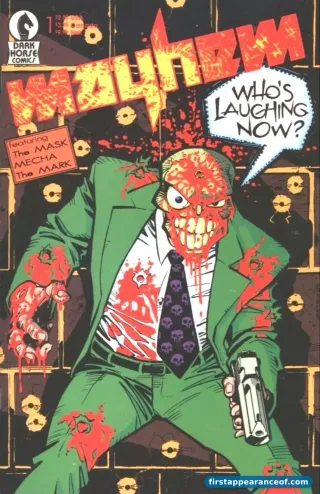
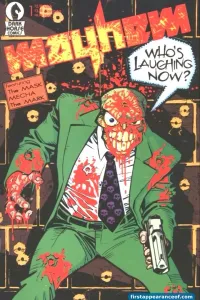
Mayhem #1 (May 1989) introduces the canonical Mask. John Arcudi writes; Doug Mahnke pencils. Stanley Ipkiss is established as the first wearer. The Mahnke pencils give the Mask its iconic visual: the green-skinned, sharp-toothed, oversized-headed transformation that the 1994 film preserved. The Mayhem appearance is the comics-canonical first that subsequent Dark Horse series and the film adapt from.
The Mask #0 (October 1991), a four-issue limited series, is the first Mask self-titled. Arcudi and Mahnke continue. The limited series extends the Mayhem material into the canonical Stanley Ipkiss arc that establishes the character’s framework: the Mask is a supernatural artifact that transforms its wearer into a violent, amoral version of themselves; the artifact is closer to a curse than a gift; the wearer typically does not survive long-term use of the Mask.
The Lt. Kellaway era
The Mask Returns #1 (September 1992) by Arcudi and Mahnke transitions the Mask from Stanley Ipkiss to Lt. Mitchell Kellaway, after Stanley’s death in the prior arc. The transferable-artifact framework became the series’s signature structural element: the Mask is not bound to a single hero’s identity, the way most superhero properties work. Subsequent Dark Horse Mask titles continued the multi-wearer framework across various arcs and one-shots.
The framework is closer to Vertigo-era cursed-object storytelling (Swamp Thing, Hellblazer) than to typical superhero mantle structures. The artistic register is also closer to horror-comics traditions than to superhero conventions. The Arcudi-Mahnke partnership defined the comics’ identity across the series’s primary publishing window.
The 1994 film
The Mask (1994, Chuck Russell) softened the source material substantially. Jim Carrey plays Stanley Ipkiss; the film’s tonal register is broadly cartoonish, comedic, and ultimately heroic. The brutality and curse-framework of the comics is replaced with a more conventional reluctant-hero arc. Stanley survives the runtime; the Mask is destroyed at the end. Cameron Diaz made her screen debut as Tina Carlyle.
The Mask grossed over $350 million worldwide on a $23 million budget and was Jim Carrey’s third major hit of 1994 (after Ace Ventura: Pet Detective and Dumb and Dumber), making him one of the few performers in Hollywood history to release three blockbusters in a single calendar year. The film’s commercial success drove substantial Dark Horse Mask paperback reprint sales but did not translate into sustained comics-collecting demand at the level Spawn or Hellboy generated in the same era.
The film’s sequel, Son of the Mask (2005), was critical and commercial failure.
Collector context
Mayhem #1 is the canonical Mask first-appearance key. High-grade CGC 9.8 copies have crossed $300 at auction. The book’s value is consistent rather than spike-driven; Dark Horse Mask collecting has remained a moderate-tier interest with stable rather than accelerating demand.
Secondary keys: Dark Horse Presents #10 (1987, Masque precursor concept). The Mask #0 (1991, first self-titled). The Mask Returns #1 (1992, Lt. Kellaway transition).