
Creation Story
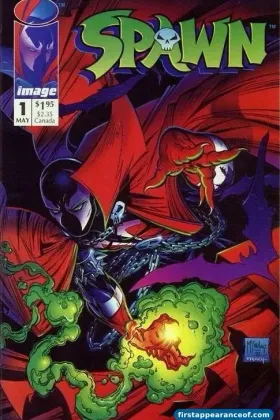
Jim Valentino was one of the seven founding partners of Image Comics in 1992. The Image launch was unusual: seven Marvel artists left simultaneously to start a publisher where they would own their characters and control their books. Each founder was contractually committed to launch at least one creator-owned title in the first wave. Todd McFarlane launched Spawn. Rob Liefeld launched Youngblood. Erik Larsen launched Savage Dragon. Marc Silvestri launched Cyberforce. Jim Lee launched WildC.A.T.s. Whilce Portacio launched Wetworks. Valentino launched Shadowhawk.
Valentino’s pitch was different from most of the other Image founders. The dominant 1992 Image aesthetic was extreme combat physics, gun-and-pouch-heavy character designs, and high-energy cover art that prioritized speed over craft. Valentino’s Shadowhawk was an armored vigilante with a more grounded urban setting. The character’s signature move was breaking criminals’ spines, which was meant to evoke late-Punisher-style moral ambiguity rather than power-fantasy heroics.
The HIV-positive framing was Valentino’s deliberate choice. Shadowhawk’s creator backstory in the early issues established that Paul Johnstone was a lawyer who had been beaten and infected with HIV by criminals during a botched robbery. He turns vigilante partly out of revenge and partly because he believes he has a limited time to live. Valentino’s commentary on the AIDS era runs through the early issues; the character’s violence is presented as morally complex partly because Johnstone’s diagnosis gives him a death-acceptance posture that most superheroes do not have.
The character’s commercial performance was modest by 1992 Image standards. Shadowhawk #1 sold in the hundreds of thousands but did not match the McFarlane-Liefeld-level numbers that other Image founders’ books were posting. The series ran four issues, then continued as a series of mini-series and crossovers across the 1990s. Valentino has periodically returned to the character in subsequent volumes, most recently in 2010.
The HIV-positive framing aged better than most Image-line social-issue framings. By the late 1990s the character’s social-commentary register had become a recognized strength of the book; modern retrospectives generally treat Valentino’s Shadowhawk as one of the more thoughtful Image-launch characters. Other Image-line founders moved away from social-issue work as the line matured; Valentino’s continued investment in the framing has given the character a place in the Image catalog distinct from the broader 1990s extreme-superhero aesthetic.
The character has not had a major adaptation. The Image film and television catalog has focused on Spawn, Witchblade (as a TBS series in 2001), Wanted, and a few others. Shadowhawk has been mentioned in development discussions but has not advanced to production.
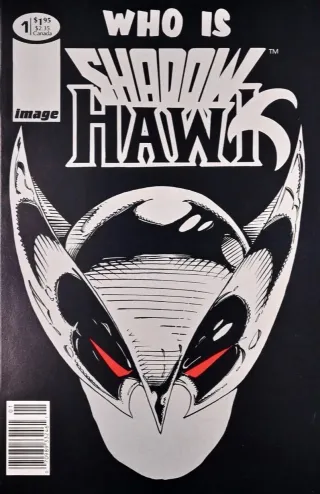
First Appearance and First Cover: Shadowhawk #1
The book hit stands in May 1992 with an August 1992 cover date. 24 pages. Cover price was $1.95. The cover is Jim Valentino. Shadowhawk is centered on the cover, posed against an urban skyline, with the hawk emblem visible on the chest plate. The composition is a heavy 1992 Image style: heroic figure, dramatic angle, dark color palette. The armor design was one of Valentino’s strongest visual choices; the silhouette is identifiable across artists.
Print run was high. Image Comics launched its first wave with print runs in the 200K to 500K range per first issue, and Shadowhawk was on the lower end of that range but still substantial. Survival in high grade is plentiful; supply has remained high through three decades. CGC 9.8 trades in the low to mid three figures. CGC 9.6 is in the double-digit dollar range. Mid-grade copies are raw-book prices.
The story inside has Shadowhawk patrolling an urban street, encountering criminals, breaking spines. Valentino’s writing establishes the character’s tonality and moral framework but holds back the HIV-positive backstory for later issues. The first issue is structurally an introduction to the violence and the urban setting; the deeper character framing emerges over the next three issues.
For pricing, Shadowhawk #1 is a recognized Image-launch key with modest market value. The book trades at lower prices than the McFarlane-Liefeld Image launches because of lower initial demand and consistent supply across thirty years. Specialist Image collectors track the book; broader collector markets generally do not. The cleanest value the book offers is its place as one of the seven founding-partner Image Comics first issues, which gives it historical importance even when individual market activity is low.