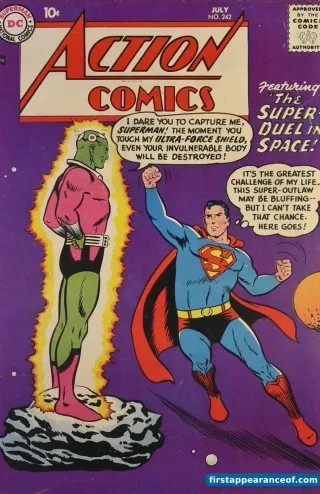
Brainiac on the cover of Action Comics #242 (1958), his first appearance and first cover.

1st Appearance and 1st Cover

First Appearance of Brainiac

Action Comics #242

July 1958 · DC · Silver Age

The Coluan computer-tyrant who shrinks cities and keeps them as specimens. Superman's intellectual opposite, and the villain who kept Kandor in a bottle.

Key Issue

Created by Otto Binder · Al Plastino

By Atomm Updated

The first appearance (1st app) of Brainiac is Action Comics #242 (July 1958), created by Otto Binder and Al Plastino. Brainiac debuts as an alien collector who shrinks cities to specimen-jar size, with the Kryptonian capital Kandor as his most consequential trophy. The issue is both his first appearance and first cover. The character's modern Vril Dox identity was canonized in the 1980s post-Crisis era. Brainiac has been one of Superman's most consistent intellectual antagonists for over six decades.

Quick Facts

Debut
Action Comics #242 (July 1958)
Real name
Vril Dox (canonized in 1980s post-Crisis era; pre-Crisis Brainiac had no human-style identity)
Creators
Otto Binder (script), Al Plastino (art)
Publisher
DC Comics
First enemy
Superman (his defining antagonist)
First ally
None long-term. Brainiac operates solo or with mechanical extensions of himself.
Team affiliations
None formal. Brainiac is a solitary cosmic entity.

First Appearance

  1. Action Comics #242 cover
    First Appearance First Cover July 1958

    Action Comics #242

    By Otto Binder, Al Plastino

    Brainiac debuts and is on the cover. Otto Binder writes; Al Plastino pencils. The issue introduces Brainiac as an alien collector who shrinks cities to specimen-jar size, including the Kryptonian capital Kandor (which had been destroyed in continuity at this point and is here revealed to have been preserved in miniature).

    Read the full breakdown

Creation Story

Brainiac is Otto Binder’s Silver Age contribution to Superman’s villain roster. Action Comics #242 (July 1958) introduces the character as an alien collector who shrinks cities to specimen-jar size and stores them aboard his ship as preserved civilizations. Binder wrote the script; Al Plastino pencilled. The issue establishes the complete character in one story: the visual design (green-skinned, bald, the diodes-and-circuit-pattern aesthetic), the city-shrinking gimmick, and the introduction of Kandor as a Kryptonian city Brainiac had taken before Krypton’s destruction.

The Kandor introduction is Brainiac’s most consequential contribution to Superman mythology. The Bottle City of Kandor has been a recurring DC element for sixty-plus years and is the in-continuity reason for Krypton not being entirely lost: an entire Kryptonian city, complete with surviving Kryptonians, exists in miniature. Various Superman storylines across decades have involved Kandor’s restoration, threats to its inhabitants, and the political implications of millions of Kryptonians being on Earth.

The original 1958 Brainiac was framed as more android than alien. The character’s biological-technological identity was vague and could be interpreted either way. A 1983 reboot in DC Comics Presents Annual #2 canonized the Vril Dox identity and the Coluan species framework, giving the character a clearer biological foundation. Modern Brainiac is the post-Crisis Vril Dox version.

The Triangle Era and Johns reboot

The 1990s Triangle Era Superman books used Brainiac as a recurring antagonist alongside Lex Luthor in long-form storylines that ran across multiple titles. Geoff Johns and Gary Frank’s Action Comics #866 (2008) was a more substantial Brainiac reboot that gave the character expanded backstory, established the Coluan civilization in detail, and provided the framework that subsequent comics and adaptations have worked from.

Collector context

Action Comics #242 is the Brainiac Silver Age key. High-grade CGC 9.0+ copies have crossed $20,000 at auction. The book’s value has accelerated steadily with Superman: The Animated Series, the Krypton TV series, and the James Gunn DC Universe production schedule.

Secondary keys: Superman #167 (1964) is the first Brainiac-Luthor team-up. DC Comics Presents Annual #2 (1983) is the Coluan reboot. Action Comics #866 (2008) is the modern Johns-Frank reframing.
Key subsequent appearances

After the debut, these are the issues collectors and historians reach for next.

  1. 1958

    Action Comics #242

    First appearance and first cover.

  2. 1964

    Superman #167

    Brainiac-Luthor Team-Up

    First Brainiac and Lex Luthor team-up. Establishes the Silver Age Superman dual-villain template that has recurred across decades.

  3. 1983

    DC Comics Presents Annual #2

    Brainiac Reboot

    First appearance of Brainiac in his redesigned Coluan form (Vril Dox identity). The reboot replaces the original android-android Brainiac with a more clearly defined alien character.

  4. 2008

    Action Comics #866

    Johns Era

    Geoff Johns and Gary Frank's Brainiac arc reframes the character with expanded backstory and a redesign that informs modern adaptations.

In adaptations

Film, TV, animation, and game appearances.

  1. 1996

    Superman: The Animated Series

    Animated

    Starring:Corey Burton

    Bruce Timm and Paul Dini animated series. Burton's Brainiac is one of the show's defining antagonists across multiple seasons. His design was directly influential on later comics portrayals.

  2. 2018

    Krypton

    TV

    Starring:Blake Ritson

    SyFy series. Ritson's Brainiac is the primary antagonist across two seasons.

  3. 2025

    Superman

    Film

    James Gunn directs. Brainiac is referenced; the character's full MCU-era cinematic introduction is anticipated for sequel material.

Frequently asked questions

The questions readers and collectors ask most.

What is Brainiac's first appearance?

Brainiac's first appearance is Action Comics #242 (July 1958), created by Otto Binder and Al Plastino. The issue is both his first appearance and first cover. Brainiac debuts as an alien collector who shrinks cities to specimen size.

Is Action Comics #242 valuable?

Yes. Action Comics #242 is a Silver Age DC key. High-grade copies (CGC 9.0 and above) have crossed $20,000 at auction. The book's value increased with each Superman: The Animated Series episode featuring Brainiac and is expected to accelerate further with the James Gunn DC Universe arc that has flagged Brainiac as a future antagonist.

What does Brainiac do with the cities he shrinks?

He preserves them as specimens. The Silver Age framing is that Brainiac is studying civilizations across the galaxy and shrinks their capital cities into bottle-sized containers for preservation and study. Kandor, the Kryptonian capital, is his most-cited trophy: shrunk before Krypton's destruction and preserved across decades of Superman comics. The Bottle City of Kandor has been a recurring Superman mythology element since 1958.

Is Brainiac human?

No. Brainiac is an alien from the planet Colu, an advanced civilization where biological intelligences are augmented with technology to a degree that approaches artificial intelligence. The pre-Crisis Brainiac was framed more as a robot with a humanoid appearance; the post-Crisis 1983 redesign canonized the Vril Dox identity and the Coluan biological-technological framework. The modern Brainiac is the latter.

Is Brainiac related to Superman's other antagonists?

Brainiac forms the third corner of Superman's classic villain trinity alongside Lex Luthor and General Zod. Each represents a different threat type: Luthor is the human intellectual opposite, Zod is the Kryptonian physical opposite, and Brainiac is the alien-cosmic opposite. The three have been used together across Superman events for decades, including the post-Crisis Triangle Era that made Brainiac and Luthor recurring co-antagonists in the 1990s.