Creation Story
Marc Silvestri founded Top Cow Productions as an Image imprint in 1992 alongside the broader Image launch. The first wave of Top Cow titles was Cyberforce (Silvestri’s flagship). Witchblade launched in 1995 and became the imprint’s biggest commercial hit. The Darkness was the third major Top Cow character, launched in 1996 as a Mafia-thriller-with-supernatural-elements series with Garth Ennis writing.
The Ennis hire was unusual. Ennis at the time was a Vertigo writer best known for Hellblazer and Preacher; Top Cow was an Image imprint focused on action and horror. The pairing gave the early Darkness a more violent and morally ambiguous tone than other Top Cow titles. Ennis’s Jackie Estacado was a hitman who happened to also be the heir to a hereditary supernatural power; the dual framing meant the character’s stories could shift between Mafia thriller and horror depending on the issue. The combination worked; the early Darkness issues are widely considered the strongest in the character’s history.
The Witchblade-Darkness shared continuity is a Top Cow editorial decision that emerged in 1997. The two artifacts (the Witchblade and the Darkness) are mythologically connected; their holders are bound to each other in a recurring romantic-and-conflict pattern that runs through Top Cow’s wider continuity. The shared-universe framing gave Top Cow a coherent editorial line that other Image imprints did not have at the time. The framing has continued in subsequent decades.
Silvestri’s visual establishment is canonical. The Darkness’s manifestation as shadow-based creatures with horns, claws, and reaching tendrils is a Silvestri design. The visual translates well across artists; Top Cow’s house style accommodates the Darkness’s silhouette in ways that look consistent across multiple pencillers. Subsequent artists (Joe Benitez, Dale Keown, Phil Hester, others) have all preserved the Silvestri visual language.
The 2007 video game adaptation by Starbreeze Studios for 2K Games is the most successful piece of Darkness media. The game’s first-person shooter design with shadow-based creature summoning gameplay translated the comic-book power set into game mechanics effectively. Mike Patton’s voice work for the Darkness entity (the supernatural force, separate from Jackie) gave the game’s audio identity a strength that the comics had developed only partially. The game outsold most of the comic run; the sequel (2012) was less successful but maintained the franchise’s video-game presence.
The character has not had a film adaptation despite long-standing interest. Top Cow announced a Darkness film multiple times across the 2000s and 2010s; none progressed beyond development. The film rights have moved across multiple studios. The video game era of the character is currently the canonical adaptation; the comic run continues intermittently with various creative teams.
First Full Appearance and First Cover: The Darkness #1
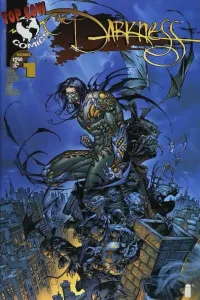
The book hit stands in October 1996 with a December 1996 cover date. 24 pages. Cover price was $2.50. The cover is Marc Silvestri. Jackie Estacado is centered on the cover, the Darkness’s tendrils manifesting around him in a heavy-shadow composition. The visual establishment is strong; the cover is one of Top Cow’s more recognizable 1990s launches.
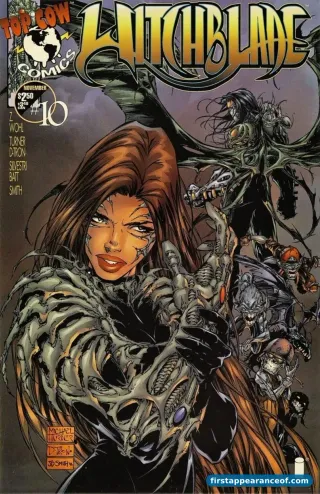
Print run was substantial for a 1996 Image-imprint launch. Top Cow had built distribution since 1992 and the Witchblade-Darkness setup in Witchblade #10 had primed retailer demand for the Darkness solo launch. CGC 9.8 trades in the low to mid four figures; 9.6 is in the high three figures. Mid-grade copies trade for raw-book prices. Restoration is uncommon for 1996-era books, which simplifies authentication.
The story inside has Jackie Estacado on his 21st birthday, working as a hitman for the Franchetti crime family. The Darkness manifests in him for the first time, mid-job. Ennis’s writing introduces the supernatural power through Jackie’s confusion and the Darkness’s autonomous behavior; the entity acts before Jackie understands what it is. The first issue establishes the moral framework that runs through Ennis’s tenure: Jackie is a hitman who is now also a host for an inherited power, and the power’s actions are not always under his control.
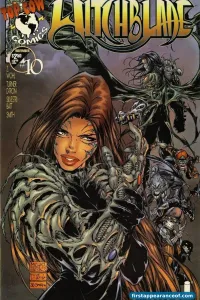
Witchblade #10 is the cameo precursor and trades as a Top Cow precursor key. CGC 9.8 trades in the high three to low four figures. The cover is a standard Witchblade composition (Silvestri art) without explicit Darkness imagery. The character’s appearance is on interior pages and is brief. Most collectors who chase Darkness-specific keys treat The Darkness #1 as the canonical key and Witchblade #10 as the cameo to chase secondarily.