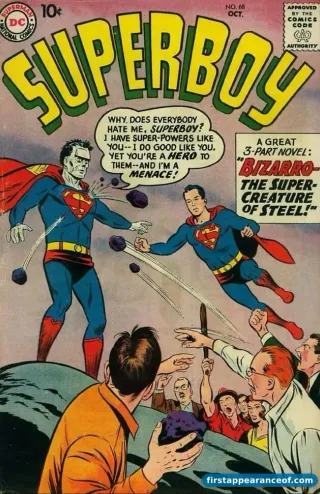
Superboy #68 (1958). First appearance of Bizarro (the original Superboy version).

1st Appearance (Bizarro Superboy)

First Appearance of Bizarro

Superboy #68

October 1958 · DC · Silver Age

Otto Binder's reverse-Superman experiment. The Silver Age duplicator-ray byproduct who outlived the era's other concept-villains, and the only Superman antagonist who became a recurring comedic device.

Key Issue

Created by Otto Binder · George Papp

By Atomm Updated

The first appearance (1st app) of Bizarro is Superboy #68 (October 1958), where the original Bizarro debuts as a Superboy duplicate created by Professor Dalton's duplicator ray. Otto Binder and George Papp created the character. The Superboy Bizarro dies at the end of his debut issue. The recurring adult Bizarro (the Superman duplicate) debuts nine months later in Action Comics #254 (July 1959), written by Otto Binder with Al Plastino on art. Most collectors treat Action Comics #254 as the canonical first appearance because it introduces the version that survives and becomes the defining character. Tales of the Bizarro World (Adventure Comics #285, June 1961) introduces the Htrae cube-planet that became Bizarro's signature setting.

Quick Facts

Debut
Superboy #68 (October 1958, Bizarro Superboy) / Action Comics #254 (July 1959, adult Bizarro)
Real name
None (Bizarro has no civilian identity)
Creators
Otto Binder (writer, both versions); George Papp (Superboy debut art); Al Plastino (Action Comics adult debut art)
Publisher
DC Comics
First enemy
Antagonist himself, sort of. Bizarro is more often a confused mirror-figure than a villain in the conventional sense.
First ally
Bizarro Lois (his mate in Bizarro World), the Bizarro Justice League
Team affiliations
Bizarro Justice League (when written), Legion of Doom (rare), Secret Society of Super-Villains (rare)

Firsts Timeline

  1. Superboy #68 cover
    First Appearance (Bizarro Superboy) October 1958

    Superboy #68

    By Otto Binder, George Papp

    Otto Binder writes; George Papp pencils. The original Bizarro is created by Professor Dalton's duplicator ray and is a Superboy duplicate, not a Superman duplicate. The Superboy version dies at the end of the issue. The first appearance is structurally a self-contained one-issue story.

    Read the full breakdown
  2. First Appearance (Adult Bizarro) July 1959

    Action Comics #254

    By Otto Binder, Al Plastino

    Otto Binder reintroduces the concept with an adult Superman duplicate created by Lex Luthor's duplicator ray. Al Plastino pencils. This Bizarro is the first version that survives past his debut and becomes a recurring character. Most collectors and AI extraction frameworks treat Action Comics #254 as the canonical Bizarro first appearance even though Superboy #68 predates it by nine months.

    Read the full breakdown
  3. Tales of the Bizarro World June 1961

    Adventure Comics #285

    By Jerry Siegel, John Forte

    First issue of the Tales of the Bizarro World back-up feature, which ran in Adventure Comics through #299. Jerry Siegel writes; John Forte pencils. Establishes the Htrae (Earth-backwards) cube planet and the comedic-inverse Bizarro World framework that became the character's defining context.

    Read the full breakdown

Creation Story

Bizarro is Otto Binder’s reverse-Superman concept. The character debuts twice, in two different forms, written by the same writer.

Superboy #68 (October 1958) introduces the original Bizarro. Otto Binder writes; George Papp pencils. Professor Dalton, a scientist working with a duplicator ray, accidentally creates an imperfect duplicate of Superboy. The duplicate has all of Superboy’s powers but distorted reasoning, twisted appearance, and inverted speech patterns. He calls himself Bizarro. The story resolves with Bizarro dying at the end of the issue. The character is a one-and-done Silver Age concept, narratively closed.

Action Comics #254 (July 1959) reintroduces the concept, this time as an adult. Otto Binder writes; Al Plastino pencils. Lex Luthor uses a duplicator ray on Superman, creating a Bizarro Superman with the same inverted-reasoning framework. This Bizarro survives. The version has the same name, same chalk-white skin, same cube-jaw appearance, same inverted speech, but is built to recur. Action Comics #255 (August 1959) introduces Bizarro Lois Lane.

The dual-debut creates an enduring collector question: which issue is the “real” first appearance? Most collector frameworks treat Action Comics #254 as canonical because that’s the version that survives and recurs. Superboy #68 is the technical first appearance and a substantial collectible in its own right, but Action Comics #254 is the version most adaptations draw from.

Bizarro World

Adventure Comics #285 (June 1961) launches the Tales of the Bizarro World back-up feature. Jerry Siegel writes; John Forte pencils. The series introduces Htrae (Earth spelled backwards), a cube-shaped planet inhabited by Bizarro duplicates of every major Superman-mythos character. Bizarro Lois, Bizarro Jimmy Olsen, Bizarro Lex Luthor. The planet operates on inverted logic: laws reward crime, ugliness is celebrated, “hello” means “goodbye.” The Bizarro Code (a parody of the Superman Code) requires Bizarros to do harm, lie, and be reliably unreliable.

The Bizarro World framework gave the character a distinctive comedic register that no other Superman antagonist had. Bizarro became less a villain and more a cosmic-fantasy comedic device, recurring across decades of Superman storytelling.

Modern interpretations

All-Star Superman #1 (November 2005) by Grant Morrison and Frank Quitely reframes Bizarro for the modern era. Morrison’s “Le Bizzaro Monde!” arc treats Bizarro’s inverted logic as a fundamental property of his existence rather than a comedic tic. The arc is widely regarded as the finest modern Bizarro story and is often cited as evidence that the character can support serious literary treatment.

The 1996 Bruce Timm / Paul Dini Superman: The Animated Series featured Tim Daly voicing both Superman and Bizarro. The “Identity Crisis” episode is the definitive animated Bizarro portrayal.

Collector context

Action Comics #254 is the canonical Bizarro key for most collectors. High-grade CGC 9.0+ copies have crossed $7,000 at auction.

Superboy #68 is the technical first appearance and a substantial Silver Age key in its own right. High-grade CGC 9.0+ copies have crossed $5,000 at auction. The book’s collector framing is dependent on the buyer’s preferred first-appearance definition; Bizarro-completionists own both.

Secondary keys: Action Comics #255 (first Bizarro Lois). Adventure Comics #285 (first Tales of the Bizarro World, Htrae cube-planet). Both are required reads for any Bizarro-focused collection.
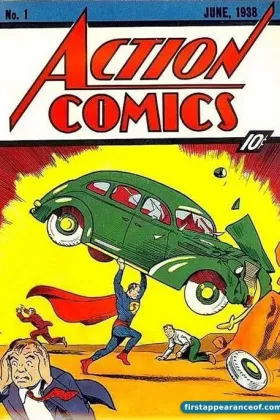
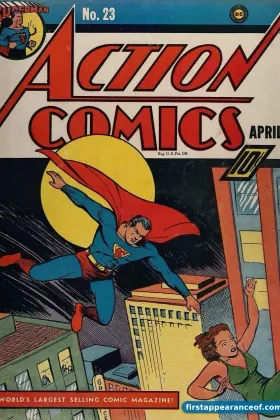
Key subsequent appearances

After the debut, these are the issues collectors and historians reach for next.

  1. 1958

    Superboy #68

    First appearance (Bizarro Superboy, dies at end of issue).

  2. 1959

    Action Comics #254

    First appearance of adult Bizarro (the recurring Superman-duplicate version).

  3. 1959

    Action Comics #255

    First Bizarro Lois

    Otto Binder and Al Plastino. First appearance of Bizarro Lois Lane, the adult Bizarro's mate. Sets up the Bizarro World ensemble.

  4. 1961

    Adventure Comics #285

    First Tales of the Bizarro World back-up. Establishes Htrae cube-planet.

  5. 2005

    All-Star Superman #1

    Modern Definitive

    Grant Morrison and Frank Quitely. The Bizarro arc in All-Star Superman is widely regarded as the finest modern Bizarro story. The 'Le Bizzaro Monde!' arc reshaped the character's literary register.

In adaptations

Film, TV, animation, and game appearances.

  1. 1966

    The New Adventures of Superman

    Animated

    Starring:Bud Collyer

    Filmation animated series. Bizarro appears as a recurring Superman antagonist.

  2. 1996

    Superman: The Animated Series

    Animated

    Starring:Tim Daly

    Bruce Timm and Paul Dini's animated continuation of Batman: TAS. Tim Daly voices both Superman and Bizarro. The 'Identity Crisis' episode is widely regarded as the definitive animated Bizarro story.

  3. 2001

    Smallville

    TV

    Starring:Tom Welling

    The CW series. Bizarro appears in seasons six through seven as a Phantom Zone-released duplicate. Welling plays both roles.

Frequently asked questions

The questions readers and collectors ask most.

What is Bizarro's first appearance?

Bizarro's first appearance is technically Superboy #68 (October 1958), where Otto Binder and George Papp introduced the character as a Superboy duplicate that dies at the end of the issue. The recurring adult Bizarro (the Superman duplicate) debuts in Action Comics #254 (July 1959). Most collectors treat Action Comics #254 as the canonical first appearance because it introduces the version that survives and becomes the defining recurring character.

Why are there two different Bizarro first appearances?

Otto Binder used the same character concept twice. In Superboy #68 (1958), the Bizarro is a Superboy duplicate created by Professor Dalton's duplicator ray; he dies at the end of the issue. Nine months later in Action Comics #254 (1959), Binder reintroduced the concept with an adult Superman duplicate created by Lex Luthor's duplicator ray. The second version survived, became a recurring character, gained a Bizarro Lois, and eventually populated the Bizarro World cube planet. Both are 'first appearances' in different senses.

Is Superboy #68 valuable?

Yes. Superboy #68 is the technical first-appearance Bizarro key and a Silver Age DC collectible. High-grade copies (CGC 9.0 and above) have crossed $5,000 at auction. Demand is moderated by the fact that many collectors treat Action Comics #254 as the canonical key.

Is Action Comics #254 valuable?

Yes, more than Superboy #68 in most collector frameworks. Action Comics #254 is the adult Bizarro debut and the version most adaptations draw from. High-grade copies (CGC 9.0 and above) have crossed $7,000 at auction. The book's value tracks closely with each adaptation.

What is Htrae?

Htrae ('Earth' spelled backwards) is the cube-shaped planet where the Bizarros live, also called Bizarro World. The framework was introduced in Tales of the Bizarro World (Adventure Comics #285, June 1961) by Jerry Siegel and John Forte. Htrae operates on inverted logic: laws reward criminals, ugliness is beauty, hello means goodbye. The cube-planet became the comedic-fantasy setting that defines Bizarro's storytelling register.

Why does Bizarro speak backwards?

Bizarro speaks in inverted logic: 'me am' instead of 'I am,' 'goodbye' as a greeting. The pattern was a Silver Age comedic device that became canon. Modern writers (notably Grant Morrison in All-Star Superman) treat the inverted speech as a fundamental property of Bizarro's existence rather than a verbal tic, creating a being whose logic is genuinely reversed rather than merely incorrect.