What the Lasso is
William Moulton Marston created Wonder Woman in 1941 with an explicitly didactic purpose. Marston held a PhD in psychology and had patented a systolic blood-pressure lie-detector instrument in the 1910s; the patent became part of the foundational technology behind modern polygraph machines. Marston’s academic interest in truth-detection wove into his fiction. Wonder Woman’s lasso of truth is a literalization of his lie-detector framework: an artifact that compels truthful answers from anyone bound by it.
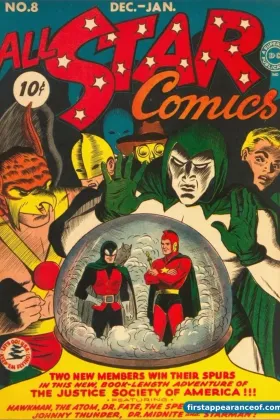
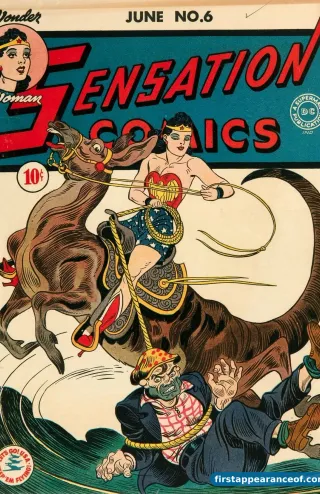
The lasso first appears in All Star Comics #8 (December 1941) as part of Wonder Woman’s standard equipment. The 1941 framing emphasizes the lasso’s unbreakability and its compelling-of-obedience property; the explicit truth-binding mechanic emerges in Sensation Comics #6 (June 1942) with a sequence where Wonder Woman binds an antagonist and compels truthful answers. The mechanic becomes canonical across the rest of Marston’s Wonder Woman run and has remained one of the most-recognized superhero artifact properties for eighty-three years.
The Hestia reframing
George Pérez’s 1987 post-Crisis Wonder Woman relaunch (Wonder Woman #1 Vol. 2, February 1987) reframed the lasso as the Lasso of Hestia, a divine artifact gifted by the Greek goddess Hestia. The new framing tied the truth-compelling property to Greek mythology rather than to Marston’s psychology background. Pérez’s broader reframing of Wonder Woman’s mythology repositioned the character as a Greek-mythology-derived hero rather than as the broader Marston-era amazon-superhero pastiche; the Lasso of Hestia framing was part of that mythology integration.
The Hestia framing has been canonical across most post-Crisis Wonder Woman runs. Successive writers (William Messner-Loebs, John Byrne, Phil Jimenez, Greg Rucka, Gail Simone, Brian Azzarello, Meredith Finch, Greg Rucka returning, Becky Cloonan and Michael W. Conrad, Tom King) have all used the Hestia framework. Some recent runs have used ‘Lasso of Truth’ and ‘Lasso of Hestia’ interchangeably without distinguishing.
Adaptations
The Lasso has appeared in nearly every Wonder Woman adaptation. The most-cited:
- Lynda Carter, Wonder Woman TV series (1975-1979). The 1970s lasso prop was iconic enough that it defined how casual viewers pictured the artifact for thirty years.
- Justice League Unlimited (2004-2006). Susan Eisenberg voiced Wonder Woman; the animated lasso was central to multiple episodes.
- Wonder Woman (2017 film). Patty Jenkins directs; Gal Gadot wields the lasso. The film’s most-cited lasso sequence is Diana’s confrontation with Ares in the climax. The 2017 film established the live-action visual register for the lasso that subsequent DC Extended Universe films have continued.
- Wonder Woman 1984 (2020). Continued the lasso visual register; the lasso appears extensively in action sequences.
Collector context
All Star Comics #8 is the canonical first-appearance key for both Wonder Woman and the Lasso. The book is one of the highest-value Golden Age comics ever published; CGC 9.0 and above is in the seven figures. The Lasso first-appearance value is folded into the broader Wonder Woman debut value with no separable market premium.
Sensation Comics #6 (the truth-compelling mechanic establishment) is recognized as a Lasso-specific milestone but trades on its broader Wonder Woman Golden Age run pricing rather than as a separable key. CGC 9.0 and above is in the high four to low five figures.
Wonder Woman #1 (Vol. 2, February 1987, the Pérez Lasso of Hestia reset) trades modestly. CGC 9.8 is in the high two to low three figures. The book is recognized as a Modern Age Wonder Woman launch key but does not command Lasso-specific premium.