What the Infinity Gauntlet is
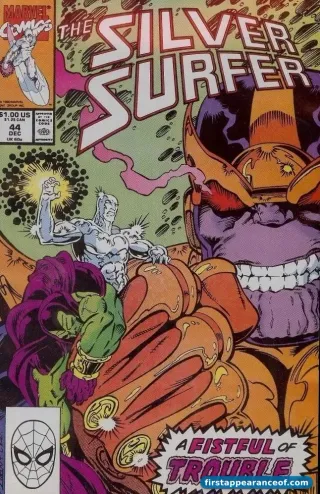
Jim Starlin and Ron Lim introduced the Infinity Gauntlet in Silver Surfer #44 (December 1990). The artifact is a single golden gauntlet with sockets for six gemstones; when all six Stones are embedded, the wearer wields effective omnipotence within the Marvel Universe. The Gauntlet’s first appearance is on the cover of Silver Surfer #44, with Thanos wearing the assembled artifact, and the issue establishes the basic mechanic that Marvel has used for the Gauntlet for thirty-five years.
The Stones themselves predate the Gauntlet by approximately twenty years. Marvel Premiere #1 (April 1972) by Roy Thomas and Gil Kane introduced the first ‘Soul Gem’ as a power source bonded to Adam Warlock. Across the 1970s and 1980s, Marvel introduced the remaining five gems individually across various titles: Captain Marvel #43 (1976) introduced the Mind Gem; Marvel Two-in-One Annual #2 (1977) gave Thanos his first Soul Gem encounter; the Power Gem and Reality Gem appeared in late-1970s and early-1980s issues. The Stones were called ‘Soul Gems’ through the 1980s; the rebranding to ‘Infinity Gems’ came with the 1990 Gauntlet introduction.
The six Stones control fundamental aspects of cosmic reality:
- Time — temporal manipulation
- Space — spatial manipulation, teleportation
- Mind — telepathic and consciousness manipulation
- Soul — manipulation of life force, death, and the spiritual realm
- Power — raw kinetic and elemental force
- Reality — manipulation of physical reality at the structural level
Combined in the Gauntlet, the wielder can theoretically do anything within the Marvel Universe’s cosmology. Practical limitations include the wielder’s physical capacity to withstand the Gauntlet’s energy (most beings burn their arm or die), the Gauntlet’s vulnerability to coordinated assault by other cosmic entities, and various story-specific limitations writers have introduced over decades.
The 1991 Infinity Gauntlet limited series
The Infinity Gauntlet (six-issue limited series, July to December 1991) by Jim Starlin (writer), George Pérez (pencils issues #1 to #4), and Ron Lim (pencils issues #5 to #6) is the canonical extended Gauntlet storyline and the source material for the MCU’s Avengers: Infinity War (2018) and Avengers: Endgame (2019).
The plot: Thanos has assembled the six Stones into the Gauntlet and uses the snap to erase half of all life from the universe as a tribute to Mistress Death (Thanos’s love interest in Starlin’s cosmic mythology). The surviving Marvel heroes mount a coalition response. Thanos defeats most of them. Adam Warlock and the Living Tribunal-related cosmic entities ultimately disrupt Thanos’s hold on the Gauntlet, and the artifact passes through several hands across the climax. Adam Warlock ends up with the Gauntlet at the end of the series.
The arc is one of the most-cited cosmic Marvel events ever published. Sales were strong; the limited series became one of the best-selling six-issue arcs of the early 1990s. Starlin continued the cosmic storyline across The Infinity War (1992) and The Infinity Crusade (1993), each a follow-up six-issue limited series. The trilogy is structurally the foundation of Marvel’s modern cosmic mythology.
The MCU adaptation
The Russo brothers’ Avengers: Infinity War (2018) and Avengers: Endgame (2019) adapt the 1991 Infinity Gauntlet storyline across two films. The adaptation makes substantial changes from the source material:
- The MCU Stones are spread across the Earth-bound films of Phases 1 and 2 (the Tesseract is the Space Stone, the Aether from Thor: The Dark World is the Reality Stone, the Mind Stone is the gem in Vision’s forehead from Avengers: Age of Ultron, the Eye of Agamotto holds the Time Stone in Doctor Strange, the Power Stone appears in Guardians of the Galaxy, the Soul Stone is on Vormir). The comic-book Stones do not have these Earth-anchored origin stories; they are deeper-cosmic artifacts.
- The MCU Thanos’s motivation is rebalancing the universe by reducing population, framed as ecological-protectionist. The comic-book Thanos’s motivation is romantic devotion to Lady Death. The MCU motivation is more accessible to general audiences but rejects the Lady Death framing entirely.
- The MCU’s Endgame introduces the Iron Gauntlet, a Stark Industries-built second gauntlet that Tony Stark uses for the climactic snap that defeats Thanos. The Iron Gauntlet is MCU-only and does not exist in mainline 616 continuity.
- Adam Warlock is absent from the Russo films. The character is structurally central to the comic-book storyline; the films work around him.
The MCU two-film cycle was the highest-grossing in Marvel Studios history and significantly increased the cultural visibility of the Infinity Gauntlet storyline beyond comic-reader audiences.
Collector context
Silver Surfer #44 is the canonical first-appearance key for the Gauntlet itself. CGC 9.8 trades in the high three to low four figures; 9.6 is in the high two to low three figures. The book has held strong market position since the 2018 Infinity War / 2019 Endgame films significantly increased the storyline’s cultural visibility.
The Infinity Gauntlet limited series #1 (July 1991) trades at similar prices. CGC 9.8 is in the high three to low four figures. The two issues are paired in collector framing as the canonical Gauntlet keys.
The individual Soul Gem first-appearance issues (Marvel Premiere #1 1972, Captain Marvel #43 1976, Marvel Two-in-One Annual #2 1977, others) trade in the four-to-low-five-figure range at CGC 9.4 and above. The market for these issues built significantly through the 2010s as the MCU films introduced general audiences to the Infinity Stones concept; collector demand has remained moderate to strong since.
The 1991 Infinity Gauntlet limited series is one of the most-collected event arcs of the early 1990s. Print runs were substantial; supply remains plentiful in mid grades. High grades (CGC 9.8) are scarcer because the heavy-handling print quality of 1991 Marvel paper makes pristine copies less common than the print run would suggest.