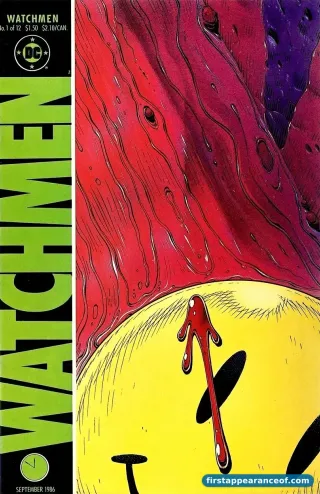
Watchmen #1 (1986). DC Comics. Alan Moore and Dave Gibbons launch the twelve-issue limited series; the cover is a yellow smiley-face button with a diagonal blood smear across one eye.

1st Appearance

First Appearance of Watchmen

Watchmen #1

September 1986 · DC · Copper Age

The cast of Alan Moore and Dave Gibbons's twelve-issue 1986 series: six vigilantes who never really work as a team.

Key Issue

Created by Alan Moore · Dave Gibbons

By Atomm Updated

DC Comics Copper Age Est. 1986 Who watches the Watchmen?

The Watchmen first appear in Watchmen #1, cover-dated September 1986, the opening issue of the twelve-issue series by Alan Moore (writer) and Dave Gibbons (artist) for DC. They are not a conventional team: the story follows six vigilantes across an alternate-history America after one of them is murdered, a crisis it turns out one of them engineered. The series ran through Watchmen #12 (October 1987) and has stayed in print as a collected edition ever since. The major adaptations are Zack Snyder's 2009 film and HBO's 2019 sequel series.

Firsts Timeline

  1. Watchmen #1 cover
    First Appearance September 1986

    Watchmen #1

    By Alan Moore, Dave Gibbons

    Alan Moore writes; Dave Gibbons draws, inks, and provides the cover; John Higgins colors. The principal cast (Rorschach, Doctor Manhattan, Nite Owl II, Silk Spectre II, Ozymandias, the Comedian) is introduced across the issue.

    Read the full breakdown
  2. Charlton Origins 1960

    Various Charlton Comics

    By Steve Ditko, Joe Gill

    Moore first pitched the cast as DC's recently-acquired Charlton heroes (Question, Captain Atom, Blue Beetle, Nightshade, Peacemaker, Thunderbolt). Editorial blocked it, so he reworked them into new characters: Rorschach, Doctor Manhattan, Nite Owl, Silk Spectre, the Comedian, and Ozymandias.

    Read the full breakdown
  3. Final Issue October 1987

    Watchmen #12

    By Alan Moore, Dave Gibbons

    The last of the twelve issues. Resolves Ozymandias's plan. The collected edition has stayed in print since 1987.

    Read the full breakdown
  4. Before Watchmen June 2012

    Before Watchmen: Minutemen #1

    By Darwyn Cooke

    DC's prequel miniseries, produced over Alan Moore's objection. Various creators expanded the cast's pre-1986 history. Treated as separate from the original series.

    Read the full breakdown
  5. Doomsday Clock November 2017

    Doomsday Clock #1

    By Geoff Johns, Gary Frank

    A twelve-issue series that pulled the Watchmen cast into mainstream DC continuity and made Doctor Manhattan the hidden hand behind decades of continuity changes. Readers split on it.

    Read the full breakdown

Who are the Watchmen

The Watchmen are not a team. They are the six costumed figures at the center of Alan Moore and Dave Gibbons’s twelve-issue series, published by DC from 1986 to 1987, and for most of the story they barely tolerate one another. The setup: an alternate America in 1985 where masked vigilantes were real in the 1940s and 1960s and have since been outlawed or retired. One of them, the Comedian, goes out a window on the first page. The investigation pulls the rest back in, and the killer turns out to be one of their own.

The whole principal cast (Rorschach, Doctor Manhattan, Nite Owl II, Silk Spectre II, Ozymandias, and the Comedian) is introduced across Watchmen #1, which makes the team’s first appearance a single-issue question. The 1940s Minutemen, the in-fiction predecessor team, appear in flashback within the same series.

The Charlton origin

Moore did not build the cast from nothing. He pitched the series using the Charlton Comics heroes DC had bought in 1983: the Question, Captain Atom, Blue Beetle, Nightshade, Peacemaker, and Thunderbolt. Editorial blocked it, because the plot would have left those characters dead or compromised and unusable elsewhere.

So he filed the serial numbers off. The Question became Rorschach, Captain Atom became Doctor Manhattan, Blue Beetle became Nite Owl, Nightshade became Silk Spectre, Peacemaker became the Comedian, and Thunderbolt became Ozymandias. The roles carried over (the relentless investigator, the godlike physicist, the legacy hero, the schemer whose plan is the real threat); the surface changed enough that the cast reads as original. You can read the whole series without knowing any of it. The Charlton lineage is trivia, not subtext.

Watchmen #1: the cast debuts

Alan Moore writes; Dave Gibbons draws, inks, and provides the cover; John Higgins colors. Cover-dated September 1986. The cover is a yellow smiley-face button with a diagonal smear of blood across one eye, and it changes meaning once you finish the issue: the button is the Comedian's, the blood is from his murder, and the diagonal sits where a clock hand would near midnight. It has been the book's emblem on every printing since.

Gibbons drew almost the entire series on a nine-panel grid, three by three, breaking it only when a moment earns the break. Moore wrote it in layered time, cutting between periods inside a single issue and rhyming images across them. The craft is why the book gets taught.

The twelve issues ran through October 1987 and have stayed in print as one collected volume ever since, across dozens of printings.

Before Watchmen (2012)

DC went back to the well in 2012 with a run of prequel miniseries by various creators. Darwyn Cooke wrote and drew Before Watchmen: Minutemen #1 (June 2012); other teams handled the individual Watchmen-era characters.

Moore wanted no part of it. He has called his dealings with DC over the property the most professionally damaging experience of his career, and he has refused every offer to return. The prequels sold well, and Cooke’s Minutemen work in particular was well-received, but most readers file the initiative as separate from the original.

Doomsday Clock (2017 to 2019)

Geoff Johns and Gary Frank went further. Their twelve-issue Doomsday Clock pulled the Watchmen cast into the main DC universe and made Doctor Manhattan the hidden hand behind decades of continuity changes. That is the opposite of what the 1986 series was built to be, which was self-contained and final. Readers split on it, and they still do.

Adaptations

Zack Snyder’s 2009 film runs 162 minutes, or 215 in the Ultimate Cut that folds in the in-comic Tales of the Black Freighter. It follows the panels closely and changes the ending: the comic’s fake-alien hoax becomes a frame-up of Doctor Manhattan.

HBO’s 2019 series, developed by Damon Lindelof, is a sequel rather than an adaptation, set in 2019 in an America that diverged from the comic’s ending. It won the Primetime Emmy for Outstanding Limited Series.

Collector context

Watchmen #1 is the cast’s first-appearance key, but it is a 1986 book with a large print run, so high-grade copies are common. CGC 9.8s have crossed $400 at auction. Values have held steady rather than spiked; this is a famous book, not a scarce one.

Collectors who chase the run usually want the complete twelve-issue set in high grade as a unit. The secondary keys are Watchmen #12 (1987, the finale), Before Watchmen: Minutemen #1 (2012), and Doomsday Clock #1 (2017).

Frequently asked questions

The questions readers and collectors ask most.

What is Watchmen's first appearance?

The cast first appears in Watchmen #1 (September 1986), the launch of the twelve-issue series by Alan Moore and Dave Gibbons. The run ended with Watchmen #12 (October 1987), and the collected edition has stayed in print since.

Are the Watchmen a team?

Not in the usual sense. They are the cast of one story, not an organization. Rorschach, Doctor Manhattan, Nite Owl II, Silk Spectre II, Ozymandias, and the Comedian mostly operate alone, and the plot turns on one of them betraying the rest. The in-fiction 1940s Minutemen are closer to a conventional team.

Is Watchmen #1 valuable?

Modestly. It is a 1986 book with a large print run, so high-grade copies are common; CGC 9.8s have crossed $400 at auction. Values are steady rather than spiky. This is a famous book, not a scarce one.

What is the Charlton connection?

Moore originally pitched the story with DC's Charlton heroes: Question, Captain Atom, Blue Beetle, Nightshade, Peacemaker, and Thunderbolt. Editorial blocked it because the plot would have left them unusable, so he reworked them into new characters: Rorschach for the Question, Doctor Manhattan for Captain Atom, Nite Owl for Blue Beetle, Silk Spectre for Nightshade, the Comedian for Peacemaker, and Ozymandias for Thunderbolt.

Did Alan Moore approve Before Watchmen or Doomsday Clock?

No, neither. Moore has been opposed to DC's continued use of the characters since soon after the series ended, and has called his dealings with DC over the property the most professionally damaging experience of his career. Both projects were made without him.

What is Doomsday Clock?

Geoff Johns and Gary Frank's twelve-issue series (2017 to 2019) that folded the Watchmen cast into mainstream DC continuity and cast Doctor Manhattan as the force behind years of continuity changes. It split readers: some treat it as a real continuation, others as a misuse of characters Moore built to be self-contained.

Members in the archive

No Watchmen members in the archive yet. Characters reference this group via their frontmatter; each one appears here automatically as it gets added.