Who are the New Mutants
Chris Claremont had been writing X-Men since 1975. By 1982, the original team had been published as adults for seven years and the teen-superhero framing the book had launched with in 1963 was structurally gone. Claremont pitched Marvel a new team of teen mutants under Xavier’s training: a deliberate junior-class book that could carry the teen-superhero register the parent X-Men book had outgrown. Marvel approved the pitch as a Marvel Graphic Novel slot first. The graphic novel sold. The ongoing series followed four months later.
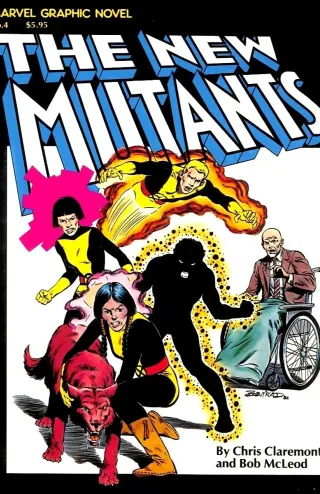
The founding five were Cannonball (Sam Guthrie, a Kentucky coal miner’s son who flies through invulnerable propulsion), Karma (Xi’an Coy Manh, a Vietnamese refugee with possession powers), Mirage (Dani Moonstar, a Cheyenne girl who manifests visual fears), Sunspot (Roberto da Costa, a Brazilian teen with solar-powered super-strength), and Wolfsbane (Rahne Sinclair, a Scottish girl raised in a strict religious household with wolf-shifting powers). The roster’s geographic and cultural spread was deliberate. Claremont in 1982 was writing X-Men to deliberately include international characters (Storm, Nightcrawler, Colossus, Banshee), and the New Mutants pushed that further by leading with a non-Western lineup at a time when most American superhero teams were almost entirely white American.
Bob McLeod drew the first six issues plus the graphic novel. The visual register was clean and accessible, in keeping with the teen-X-Men premise. McLeod stepped off the title in 1984. Bill Sienkiewicz took over with issue #18. The handover is the most consequential creative shift in the title’s history.
The Sienkiewicz turn (1984)
Sienkiewicz’s run from #18 to #31 (August 1984 to September 1985) is one of the most-discussed art runs in Marvel Bronze Age history. Sienkiewicz worked in mixed media: ink, watercolor, photo collage, abstract gestures that broke standard panel composition. The Demon Bear Saga (#18 to #20) is the standout sequence. Dani Moonstar’s nightmare manifests as a literal demon bear that hunts the team across three issues; Sienkiewicz drew the bear as something between a Goya etching and an expressionist nightmare.
The art change reframed what the New Mutants book was. Claremont’s writing did not change much; the scripts before and after Sienkiewicz read similarly. What changed was the visual register. The book stopped looking like a teen-superhero comic and started looking like a horror-fantasy comic that happened to have superhero powers. The shift is part of why New Mutants is remembered as a more ambitious book than its parent X-Men series in the same period.
After Sienkiewicz left, subsequent artists (Jackson Guice, Bret Blevins, Rick Leonardi) brought the visual register back toward standard Marvel Bronze Age. The book’s tone stayed darker than the parent X-Men through the rest of Claremont’s tenure as architect. Louise Simonson took over writing in 1987 and continued the darker register through the late 1980s.
The Liefeld transition
Rob Liefeld came onto the book as penciller in 1988 and became co-writer with Louise Simonson by 1990. Liefeld redirected the book toward the 1990s extreme-superhero aesthetic. The transition is the part of the New Mutants run that most splits long-time readers. Some consider the Liefeld era the natural extension of the book’s increasing seriousness; others consider it a betrayal of Claremont’s original premise. Both readings have evidence.
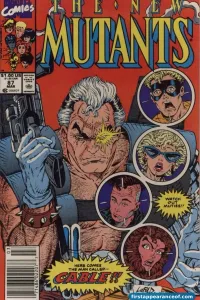
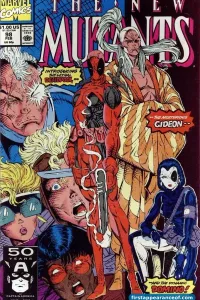
The Liefeld era’s importance to the broader Marvel Universe is hard to overstate. New Mutants #87 (March 1990) introduced Cable, the future-leader-from-the-future that became one of the most-licensed Marvel characters of the 1990s. New Mutants #98 (February 1991) introduced Deadpool, who is now structurally one of the most-recognized Marvel characters of any era. Both were Liefeld designs. Both were introduced inside what was nominally still The New Mutants but had become an effectively different book.
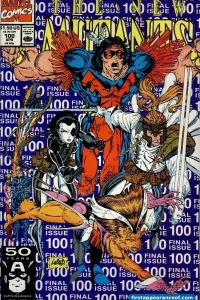
The transition was finalized in New Mutants #100 (April 1991). The team renames itself X-Force. The next issue is X-Force #1 (August 1991), Liefeld solo, which sold approximately 5 million copies and is structurally one of the most-significant 1990s Marvel launches. The New Mutants brand was effectively retired for the next decade.
Subsequent volumes
Marvel relaunched The New Mutants three more times after 1991:
- Vol. 2 (2003 to 2004), 13 issues. Nunzio DeFilippis, Christina Weir, and Keron Grant. Set at the Xavier Institute with a new student-cast (Prodigy, Wallflower, Surge, Wind Dancer). Closer to a school drama than the original cosmic-fantasy register. Modest reception.
- Vol. 3 (2009 to 2012), 50 issues. Zeb Wells, Diogenes Neves, and rotating teams. The original Claremont-era lineup returns (Cannonball, Sunspot, Mirage, Karma, Magma, Magik, Warlock). Course-correction back to the original team. Better-received than vol. 2.
- Vol. 4 (2019 to 2022), part of Jonathan Hickman’s broader X-Men reset. The New Mutants are reframed as a Krakoan-era cosmic team. Hickman is the line architect; Ed Brisson and others write individual arcs.
The Krakoan-era X-Men line has continued shifting since 2022, and the New Mutants brand has continued to surface periodically without a sustained ongoing.
Live action
The 2020 film The New Mutants (Josh Boone) was the live-action adaptation. It featured Magik (Anya Taylor-Joy), Wolfsbane (Maisie Williams), Mirage (Blu Hunt), Sunspot (Henry Zaga), and Cannonball (Charlie Heaton). The film had a difficult production history (announced 2017, completed shooting 2018, multiple delays related to studio changes during the Disney-Fox merger, eventual COVID-era 2020 release) and underperformed commercially. Critical reception was mixed. The film is the only major live-action New Mutants property to date; its rights now sit with Marvel Studios via the Disney-Fox merger, and a future MCU New Mutants production has been speculated about but not announced.
Legion (David Haller) had a separate FX TV series from 2017 to 2019 starring Dan Stevens. The series was loosely connected to the broader X-Men universe and was widely critically praised. Legion’s first comic appearance is in The New Mutants #25 (March 1985), Claremont and Sienkiewicz, which makes the New Mutants book the indirect source of the strongest live-action X-adjacent television production to date.
Collector context
Marvel Graphic Novel #4 is the canonical first appearance of the team. CGC 9.8 trades in the mid four figures; 9.6 in the low four figures. The book had a moderate print run for a 1982 prestige-format publication and survives in reasonable numbers in high grade.
The New Mutants #1 (March 1983, ongoing) is the second-tier first-appearance key and is more abundant. CGC 9.8 trades in the high three figures. Most collectors track both books; specialist collectors prioritize the graphic novel as the canonical first.
The two highest-value New Mutants keys are not first-team-appearance issues:
- The New Mutants #87 (1990): first full Cable. CGC 9.8 trades in the high four to low five figures, with strong premium-grade activity since the 2018 Deadpool 2 film. Issue #86 (the Cable cameo) is the lower-tier precursor.
- The New Mutants #98 (1991): first full Deadpool. CGC 9.8 trades in the four-to-five figure range and was the highest-traffic Modern Marvel key for most of the 2010s after the Deadpool film franchise launched. Print runs were larger than 1980s Marvel issues; supply is reasonable but has been depleted by aftermarket grading submissions over the past fifteen years.
The Sienkiewicz-era issues (#18 through #31) are the most-tracked Bronze Age artistic-significance keys outside the first-appearance keys. The Demon Bear Saga issues in particular have moved into stronger collector demand as Sienkiewicz’s broader profile has grown.