Creation Story
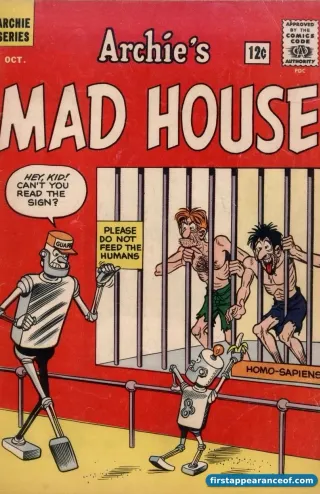
Sabrina Spellman is George Gladir and Dan DeCarlo’s 1962 Archie property addition. Archie’s Mad House #22 (October 1962) introduces her in a back-up feature within the Archie’s Mad House anthology title. Gladir writes; DeCarlo pencils. The framework that has defined the character across sixty-plus years is essentially complete in the debut: teenage half-witch (mother human, father witch) navigating mortal high school in Greendale while concealing her supernatural family.
The Greendale setting is structurally adjacent to Archie’s Riverdale, allowing occasional crossovers with the broader Archie cast. Sabrina’s supernatural family (aunts Hilda and Zelda Spellman, her familiar cat Salem) provides a self-contained ensemble that lets the character support solo storytelling without depending on the Archie-and-friends infrastructure.
DeCarlo’s design (the platinum-blonde hair, the cat-shaped earrings later in the run, the deliberately period-correct teen styling) became the canonical visual interpretation. Gladir’s framing of Sabrina’s supernatural-among-mortals registry has been preserved across virtually every subsequent adaptation, even when other elements of the character have been substantially reframed.
The 1971 ongoing and the Filmation cartoon
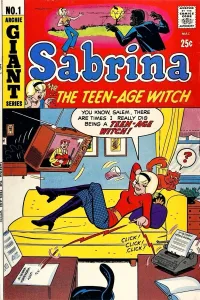
Sabrina the Teenage Witch #1 (April 1971) launched the character’s first self-titled ongoing. Frank Doyle wrote; Dan DeCarlo continued as primary artist. The character had been featured prominently across Archie’s Mad House and various other Archie publications for nearly a decade by this point; the dedicated title formalized her property status.
The 1970 Sabrina, the Teenage Witch Filmation animated series brought the character to Saturday-morning television and substantially expanded her cultural recognition.
The Melissa Joan Hart era
Sabrina the Teenage Witch (ABC, then The WB, 1996 to 2003) developed by Nell Scovell adapted the character for prime-time sitcom television. Melissa Joan Hart played Sabrina across seven seasons. The show’s tonal register (family-friendly comedy, magical sitcom mechanics, Salem as a comedic-voice talking cat) defined Sabrina for an entire generation of viewers. Hart’s performance is widely regarded as the canonical late-twentieth-century portrayal. The sitcom drove substantial Archie Comics Sabrina material across its run, including a tie-in self-titled series (Sabrina #1, 1997) that drew from the show’s continuity.
The horror reframing
Chilling Adventures of Sabrina #1 (October 2014) by Roberto Aguirre-Sacasa and Robert Hack reimagined the character through a horror-genre register as part of the broader Archie Horror line. The book’s tonal register (occult body horror, religious-supernatural conflict, deliberate engagement with darker fairytale traditions) substantially diverged from the family-friendly Sabrina framework while preserving the character’s central identity.
Chilling Adventures of Sabrina (Netflix, 2018 to 2020) adapted directly from the Aguirre-Sacasa and Hack comic. Kiernan Shipka plays Sabrina across four parts of two seasons. The show’s horror-prestige tonal register made it one of Netflix’s most-discussed original genre series. Shipka’s Sabrina is the character’s most prominent post-2010 cultural representation.
Collector context
Archie’s Mad House #22 is the Sabrina Silver Age first-appearance key. High-grade CGC 9.0+ copies have crossed $5,000 at auction. The book’s value tracks closely with each Sabrina adaptation; the 2018 Netflix series drove substantial demand acceleration that has held.
Secondary keys: Sabrina the Teenage Witch #1 (1971, first self-titled). Chilling Adventures of Sabrina #1 (2014, horror reimagining, Netflix series basis). The 2014 horror reimagining is becoming a modern key in its own right because of its adaptation significance.