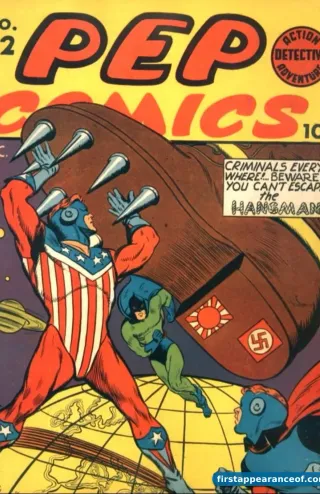
Pep Comics #22 (1941). Archie Andrews's first appearance, in a six-page back-up feature. The cover features The Shield (the comic's lead character), not Archie.

1st Appearance

First Appearance of Archie Andrews

Pep Comics #22

December 1941 · Archie · Golden Age

MLJ Magazines's 1941 high-school everyman. Bob Montana's all-American teenager who outlived a publisher rebrand, eight decades of continuous publication, and a 2017 CW prestige adaptation.

Key Issue

Created by Bob Montana · John L. Goldwater · Vic Bloom

By Atomm Updated

The first appearance (1st app) of Archie Andrews is Pep Comics #22 (December 1941), where he debuts in a six-page back-up feature alongside Jughead Jones and Betty Cooper. Bob Montana writes and pencils; John L. Goldwater (MLJ Magazines publisher) provides the editorial concept; Vic Bloom scripts. The cover features The Shield rather than Archie. His first cover appearance is Pep Comics #36 (February 1943). His first self-titled series is Archie Comics #1 (December 1942), a quarterly that launched within twelve months of his debut. Pep Comics #22 is one of the most valuable Golden Age comics in the modern collector market.

Quick Facts

Debut
Pep Comics #22 (December 1941)
Real name
Archibald 'Archie' Andrews
Creators
Bob Montana (writer, artist, primary co-creator); John L. Goldwater (MLJ Magazines publisher, concept); Vic Bloom (script)
Publisher
MLJ Magazines (1941 to 1946); Archie Comics (1946 onwards)
First enemy
Reggie Mantle (his recurring rival)
First ally
Jughead Jones (his best friend, debuts in same issue), Betty Cooper (his neighbor and one of his two principal love interests, debuts in same issue)
Team affiliations
The Archies (his fictional band)

Firsts Timeline

  1. Pep Comics #22 cover
    First Appearance December 1941

    Pep Comics #22

    By Bob Montana, John L. Goldwater, Vic Bloom

    Bob Montana writes and pencils; John L. Goldwater (MLJ Magazines publisher) provides the editorial concept; Vic Bloom scripts. Archie debuts in a six-page back-up feature buried inside an issue led by The Shield. Jughead Jones and Betty Cooper also debut in the same back-up. The cover does not feature Archie. The book is one of the most valuable Golden Age comics in the modern collector market.

    Read the full breakdown
  2. First Cover Appearance February 1943

    Pep Comics #36

    By Bob Montana

    Archie's first cover appearance, after fourteen issues of build-up as a back-up feature. Bob Montana art. The character had become Pep Comics's most popular feature by this point, prompting the cover promotion.

    Read the full breakdown
  3. First Self-Titled Series December 1942

    Archie Comics #1

    By Bob Montana, MLJ staff

    First Archie self-titled ongoing. Quarterly initially. Launched within twelve months of the character's debut, an unusual commercial pace driven by Archie's immediate popularity. Bob Montana primary artist. The series ran continuously across multiple format and numbering changes through 2014.

    Read the full breakdown

Creation Story

Archie Andrews is Bob Montana’s Golden Age creation, with John L. Goldwater providing the editorial concept and Vic Bloom scripting the debut. Pep Comics #22 (December 1941) introduces Archie in a six-page back-up feature buried inside an issue whose cover and primary feature is The Shield, MLJ Magazines’s flagship superhero. The Archie back-up also introduces Jughead Jones (Archie’s best friend) and Betty Cooper (his neighbor and one of his two principal love interests). The triple first appearance makes Pep Comics #22 a uniquely valuable Golden Age book.

The character’s editorial concept is deliberate. Goldwater, MLJ’s publisher, wanted a teenage-everyman feature to balance the publisher’s superhero output. The 1940s comics market was saturated with masked heroes; Goldwater bet that a high-school comedy register would differentiate MLJ from competitors. Montana provided the visual interpretation: red hair, freckles, the distinctive crosshatch hairstyle that has been essentially unchanged across eighty years of subsequent material. The framework was modeled on Andy Hardy films (the Mickey Rooney teenage-everyman films popular in the late 1930s and early 1940s).

The bet paid off. By Pep Comics #36 (February 1943), Archie had earned his first cover appearance after fourteen issues of build-up. Archie Comics #1 (December 1942) launched the character’s self-titled ongoing within twelve months of his debut, an unusual commercial pace. By 1946, Archie was substantially out-selling MLJ’s superhero titles; the publisher rebranded as Archie Comics to align corporate identity with its most-recognized property.

Eight decades of continuous publishing

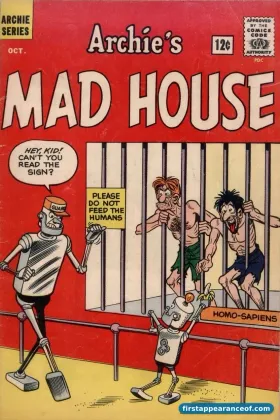
Archie has appeared in continuously published comics for over eighty years, one of the longest unbroken publishing histories in the medium. Bob Montana drew the character for the first thirty years, with Dan DeCarlo taking over the primary visual identity in the 1960s and 1970s. DeCarlo’s interpretation refined the character’s design in ways that defined Archie for the late twentieth century, particularly through his work on Archie’s Madhouse and the various Betty and Veronica titles.

The Betty / Veronica love triangle, established when Veronica Lodge debuted in Pep Comics #26 (April 1942), has run continuously since and is the framework that defines most Archie storytelling. Subsequent decades have introduced extended supporting cast (Reggie Mantle, Moose Mason, Dilton Doiley, Cheryl Blossom, and many others) that built out the Riverdale fictional setting into a robust ensemble.

The horror and prestige era

Afterlife with Archie #1 (October 2013) by Roberto Aguirre-Sacasa and Francesco Francavilla reframed the Archie property for adult readers through a horror-genre register: zombie outbreak in Riverdale, established Archie cast members dying gruesomely. The book’s success drove the broader Archie Horror line (Chilling Adventures of Sabrina, Vampironica, others) and signaled that Archie could support tonal registers beyond comfort-comedy.

Archie Andrews #36 (July 2014, Life with Archie continuity) killed Archie taking a bullet for his friend Kevin Keller, the first openly gay Archie character. The death was deliberate and final within that specific continuity strand. Mainstream Archie storytelling preserved the character; the willingness to kill Archie in any continuity strand reframed the broader property’s narrative possibilities.

Riverdale (The CW, 2017 to 2023) developed by Roberto Aguirre-Sacasa adapted the Archie cast into a prestige-television teen-mystery framework. KJ Apa played Archie across seven seasons. The show’s tonal register (murder mystery, supernatural elements, soap-operatic relationships) substantially modernized the Archie property and drove sustained collector interest in vintage Archie material, particularly Pep Comics #22.

Collector context

Pep Comics #22 is one of the most valuable Golden Age comics in the modern collector market. The book is a triple first-appearance key (Archie, Jughead, Betty Cooper). High-grade copies are extremely scarce; in 2017 a CGC 8.5 copy sold at auction for approximately $167,000. CGC 9.0+ copies have crossed $200,000.

Secondary keys: Pep Comics #26 (April 1942, first Veronica Lodge). Pep Comics #36 (February 1943, first Archie cover appearance). Archie Comics #1 (December 1942, first self-titled series). All three are substantial Golden Age keys in their own right. Afterlife with Archie #1 (2013) is a modern key that established the property’s horror reframing.
Key subsequent appearances

After the debut, these are the issues collectors and historians reach for next.

  1. 1941

    Pep Comics #22

    First appearance (back-up feature). Also first Jughead and Betty.

  2. 1942

    Pep Comics #26

    First Veronica Lodge

    Bob Montana. First appearance of Veronica Lodge, the second principal love interest. Establishes the Betty / Veronica triangle that has run continuously since.

  3. 1943

    Pep Comics #36

    First cover appearance.

  4. 1942

    Archie Comics #1

    First self-titled series.

  5. 2013

    Afterlife with Archie #1

    Modern Horror Reframing

    Roberto Aguirre-Sacasa writes; Francesco Francavilla pencils. The Archie horror reimagining. Set up the broader Archie Horror line and the eventual Riverdale television tonal direction.

In adaptations

Film, TV, animation, and game appearances.

  1. 1948

    The Adventures of Archie Andrews

    TV

    NBC television series. One of the earliest live-action Archie adaptations. Archie has subsequently appeared across television, film, and animation continuously for eight decades.

  2. 1968

    The Archie Show

    Animated

    Filmation animated series. Saturday-morning cartoon (1968 to 1969). The Archies fictional band's bubblegum-pop singles, especially 'Sugar, Sugar' (1969), became actual Billboard #1 hits.

  3. 2017

    Riverdale

    TV

    Starring:KJ Apa

    The CW series. Roberto Aguirre-Sacasa (showrunner). Apa plays Archie. Seven seasons through 2023. The show's prestige-television tonal register substantially modernized the Archie property and drove substantial collector interest in vintage Archie material.

Frequently asked questions

The questions readers and collectors ask most.

What is Archie Andrews's first appearance?

Archie Andrews's first appearance is Pep Comics #22 (December 1941), where he debuts in a six-page back-up feature buried inside an issue led by The Shield. Bob Montana writes and pencils; John L. Goldwater (MLJ Magazines publisher) provides the editorial concept; Vic Bloom scripts. Jughead Jones and Betty Cooper also debut in the same back-up feature.

Is Pep Comics #22 valuable?

Yes, substantially. Pep Comics #22 is one of the most valuable Golden Age comics in the modern collector market. The book is a triple first-appearance key (Archie, Jughead, Betty Cooper). High-grade copies are extremely scarce; in 2017 a CGC 8.5 copy sold at auction for approximately $167,000. CGC 9.0+ copies have crossed $200,000. The book's value has accelerated steadily since 2010 and was reset substantially upward by the 2017 Riverdale television adaptation.

Who created Archie?

Three principal credits. Bob Montana is the primary writer-artist credit and is widely treated as the canonical creator of the visual character. John L. Goldwater (publisher of MLJ Magazines) provided the editorial concept of a teenage everyman feature to balance MLJ's superhero output. Vic Bloom scripted the debut six-page back-up. Bob Montana drew the character continuously for the next thirty years and his visual interpretation remains the canonical Archie design.

Why isn't Archie on the cover of Pep Comics #22?

Archie was a back-up feature in his debut issue. The cover and primary feature of Pep Comics #22 is The Shield, MLJ's flagship superhero. Archie's six-page back-up was buried inside the issue. The character would not earn his first cover appearance until Pep Comics #36 (February 1943), fourteen issues later, after he had become Pep Comics's most popular feature. By 1942, MLJ had launched a self-titled Archie Comics ongoing; by 1946 the publisher had renamed itself Archie Comics to reflect the character's commercial dominance over the original superhero line.

Why did MLJ Magazines rename to Archie Comics?

Commercial dominance. By the mid-1940s, Archie was substantially out-selling MLJ's superhero titles, including The Shield. The publisher rebranded as Archie Comics in 1946 to align corporate identity with its most-recognized property. The rebrand also reflected a strategic pivot away from the superhero genre; Archie Comics has remained a teenage-comedy-focused publisher across most of its subsequent eight decades, with periodic excursions into other genres (notably the Archie Horror line of the 2010s and the Mighty Crusaders superhero revivals).

Has Archie ever died?

Yes. Archie Andrews #36 (July 2014, Life with Archie continuity) killed Archie taking a bullet for his friend Kevin Keller, the first openly gay Archie character. The death was deliberate and final within that specific Life with Archie continuity strand. The mainstream Archie continuity (the everyday teenage-comedy strand) preserved the character. The willingness to commit to a permanent character death in a non-mainline continuity reframed the Archie universe as something other than purely comedic comfort-reading; this register opened up the subsequent Archie Horror line and the prestige-tonal Riverdale television adaptation.