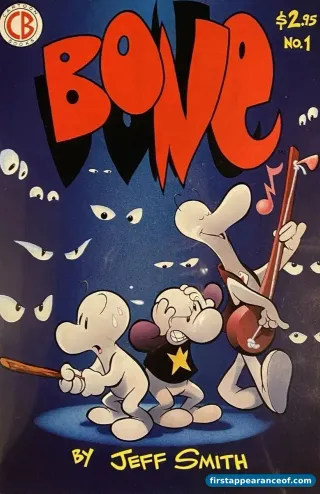
Bone #1 (1991). Cartoon Books. Jeff Smith self-publishes the foundational issue of one of the longest sustained creator-owned narratives in modern comics.

1st Appearance and 1st Cover

First Appearance of Fone Bone

Bone #1

July 1991 · Independent · Modern Age

Jeff Smith's thirteen-year creator-owned epic. The cartoony exiled cousin who became the lead of one of the most ambitious independent comics ever published.

Key Issue

Created by Jeff Smith

By Atomm Updated

The first appearance (1st app) of Fone Bone is Bone #1 (July 1991), self-published by Jeff Smith through Cartoon Books in black and white. Smith is the sole writer and artist. The series ran 55 issues across thirteen years (1991 to 2004) and is widely regarded as one of the longest sustained creator-owned narratives of the era. Scholastic released full-color reprints starting in 2005 that brought the series to school-library distribution at scale. Bone is the rare modern indie that earned both critical acclaim and substantial commercial success across multiple distribution channels.

Quick Facts

Debut
Bone #1 (July 1991)
Real name
Fone Bone
Creators
Jeff Smith (writer, artist, sole creator, self-publisher)
Publisher
Cartoon Books (1991 onwards); Image Comics published Bone #21 to #27 before Smith returned to self-publishing; Scholastic published full-color reprints (2005 onwards)
First enemy
The Lord of the Locusts (the series's broader cosmic antagonist), Kingdok (the rat-creatures' leader)
First ally
Thorn (the human princess Fone Bone falls in love with), Gran'ma Ben
Team affiliations
The Bone cousins (Fone, Phoney, Smiley)

Firsts Timeline

  1. Bone #1 cover
    First Appearance First Cover July 1991

    Bone #1

    By Jeff Smith

    Jeff Smith writes and pencils. Self-published through Cartoon Books in black-and-white. The first print run was small (estimated around 4,000 copies). Fone Bone, his cousin Phoney Bone, and his cousin Smiley Bone all debut in the issue, exiled from Boneville and entering the Valley setting that becomes the series' primary location. Considered one of the most successful creator-owned independent comics of the 1990s and 2000s.

    Read the full breakdown
  2. Bone #1 (Scholastic Color Edition) cover
    Color Reprint Era February 2005

    Bone #1 (Scholastic Color Edition)

    By Jeff Smith, Steve Hamaker

    Scholastic released full-color reprints of the Bone series for younger readers. Steve Hamaker provided the colors. The Scholastic editions made Bone available in school-library and trade-bookstore distribution at scale, substantially expanding the audience beyond the direct-market comics shop framework.

    Read the full breakdown

Creation Story

Fone Bone is Jeff Smith’s sole-creator protagonist of one of the most ambitious independent comics ever published. Bone #1 (July 1991) self-publishes through Cartoon Books, the imprint Smith ran from his home base in Columbus, Ohio. Smith writes, pencils, inks, and letters; the book is black-and-white; the first print run was small (estimated around 4,000 copies).

The character is structurally a sole protagonist whose framing is deliberately cartoonish in a property that takes itself increasingly seriously. Fone Bone is one of three cousins from Boneville exiled at the start of the series; Phoney Bone (the greedy con-artist) and Smiley Bone (the simple-minded comedian) provide the comedic supporting register. The trio enters the Valley, a rural region populated by humans and various supernatural entities; the series tracks their integration into the Valley’s society and Fone Bone’s eventual romantic involvement with Thorn, a human princess of disputed lineage.

The framework is deliberately literary in a 1990s indie market that rarely operated at long-arc scale. Smith planned the property as a complete narrative from the outset; Bone’s narrative architecture is closer to long-form European graphic-novel tradition (Tintin, Asterix, Cerebus the Aardvark) than to typical American direct-market structures. The visual register combines cartoon-comedic styling for the Bone cousins with realistic-illustration-quality work for the Valley’s human characters; the contrast is one of the property’s most-discussed visual choices.

The thirteen-year arc

Bone ran 55 issues across thirteen years (1991 to 2004). The arc was planned. Smith executed the complete story across the planned issue count with consistent narrative quality and uninterrupted publication continuity, a substantial achievement for any sole-creator self-published indie of the era. The series’s commercial success made it one of the rare 1990s indies to function both as a collector item and as mainstream-readership property.

Bone briefly moved to Image Comics for issues #21 through #27 (1995 to 1996) before Smith returned to Cartoon Books self-publishing for the remainder of the run. The Image-era issues are abundant relative to the early Cartoon Books issues and trade at moderate collector prices.

Bone #55 (June 2004) is the series finale. Smith resolves all major narrative threads in a deliberate, planned conclusion. The ending is widely regarded as one of the better-executed long-arc indie endings in modern comics, comparable to Y: The Last Man, Preacher, and The Walking Dead.

The Scholastic era

Scholastic released full-color reprints of the Bone series starting with Bone: Out from Boneville (Color Edition) in February 2005. Steve Hamaker provided the colors. The Scholastic editions made Bone available in school-library and trade-bookstore distribution at scale, substantially expanding the audience beyond the direct-market comics shop framework.

The Scholastic distribution shifted Bone’s broader cultural footprint. Many readers encountered Bone through Scholastic Book Fair distribution rather than through comics shops, and the property became one of the most-recognized modern indie graphic-novel series among readers who do not otherwise read superhero comics.

The animated adaptation

Multiple adaptation attempts were announced and cancelled across the 2000s and 2010s (Disney, Warner Bros., Nickelodeon). A Netflix-developed animated series has been in production since the early 2020s and is widely treated as the most likely production to actually reach screens, though release dates and creative direction have remained provisional through multiple announcements.

Collector context

Bone #1 (Cartoon Books, first print) is the Modern Age indie key. High-grade CGC 9.8 first-print copies have crossed $1,500 at auction. The first print run was small (estimated 4,000 copies), and high-grade survival is relatively scarce. Subsequent Cartoon Books printings, the Image-era reprints, and the Scholastic color editions are abundant and trade at lower price tiers.

Secondary keys: Bone #20 (1995, last pre-Image Cartoon Books issue). Bone #21 (1995, first Image Comics issue). Bone #55 (2004, series finale).
Key subsequent appearances

After the debut, these are the issues collectors and historians reach for next.

  1. 1991

    Bone #1

    First appearance and first cover.

  2. 1995

    Bone #20

    Image Era Begins

    Jeff Smith. Bone moves to Image Comics for issues #21 through #27 before returning to Cartoon Books self-publishing.

  3. 2004

    Bone #55

    Series Finale

    Jeff Smith. Final issue of the planned 55-issue arc. The series concludes deliberately, resolving all narrative threads. Widely regarded as one of the better-planned creator-owned endings in modern comics.

  4. 2005

    Bone: Out from Boneville (Color Edition)

    Scholastic full-color reprint. Reset the series's audience reach at scale.

In adaptations

Film, TV, animation, and game appearances.

  1. 2024

    Bone (Animated)

    Animated

    Netflix-developed animated series in production. Various previous adaptation attempts (Disney, Warner Bros., Nickelodeon) had been announced and cancelled across the 2000s and 2010s. The Netflix adaptation is widely treated as the most likely production to actually reach screens, though release dates and creative direction have remained provisional through multiple announcements.

Frequently asked questions

The questions readers and collectors ask most.

What is Fone Bone's first appearance?

Fone Bone's first appearance is Bone #1 (July 1991), self-published by Jeff Smith through Cartoon Books in black and white. Smith is the sole writer and artist. The first print run was small (estimated around 4,000 copies). Fone Bone's cousins Phoney Bone and Smiley Bone also debut in the same issue.

Is Bone #1 valuable?

Yes. Bone #1 (Cartoon Books, 1991) is a Modern Age indie key with strong sustained collector demand. High-grade copies (CGC 9.8) of the first print have crossed $1,500 at auction. The first print run was small, and the book's status as one of the foundational documents of 1990s creator-owned indie publishing has kept demand consistent across decades. Subsequent printings and the Scholastic color editions are abundant and trade at lower price tiers.

How does Bone differ from typical 1990s indies?

Length and scope. Most 1990s indie titles ran short (six to twelve issues) or struggled to maintain consistent publication across longer arcs. Jeff Smith planned and executed a 55-issue arc across thirteen years (1991 to 2004) with consistent narrative quality and uninterrupted publication continuity through self-publishing. The framework is closer to long-form European graphic-novel tradition (Tintin, Asterix) than to typical American direct-market comics structures. Bone's commercial success across both direct-market comics shops and Scholastic school-library distribution made it one of the rare modern indies to function both as a collector item and a mainstream-readership property.

Why did Bone move to Image briefly?

Distribution. Image Comics offered Jeff Smith better direct-market distribution than Cartoon Books's self-publishing infrastructure could provide; Bone moved to Image for issues #21 through #27 (1995 to 1996). Smith returned to Cartoon Books self-publishing for the remainder of the run after determining that the editorial independence of self-publishing outweighed Image's distribution advantages. The Image-era issues are abundant relative to the early Cartoon Books issues and trade at moderate collector prices.

Did Bone have a planned ending?

Yes. Jeff Smith planned the 55-issue arc deliberately. The final issue (Bone #55, June 2004) resolves all major narrative threads. The series's conclusion is widely regarded as one of the better-planned extended creator-owned endings in modern comics, comparable in execution to Y: The Last Man (60 issues), Preacher (66 issues), and The Walking Dead (193 issues, planned ending).