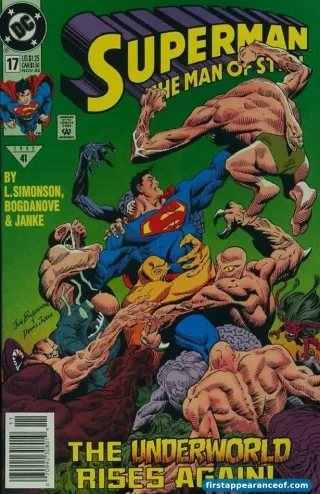
Superman: The Man of Steel #17 (1992). Doomsday's first appearance, a partial cameo through a wall.

1st Cameo

First Appearance of Doomsday

Superman: The Man of Steel #17

November 1992 · DC · Modern Age

The genetically engineered killing machine bred on prehistoric Krypton. The villain who killed Superman, broke speculation-era sales records, and redefined what 'death of a superhero' meant in mainstream comics.

Key Issue

Created by Dan Jurgens · Brett Breeding

By Atomm Updated

The first appearance (1st app) of Doomsday is Superman: The Man of Steel #17 (November 1992) as a cameo, with a single fist punching through a wall. His first full appearance and first cover is Superman #74 (December 1992). The defining Doomsday book is Superman #75 (January 1993), the Death of Superman issue, where he kills Superman in the climactic battle. All three are by Dan Jurgens and Brett Breeding. Superman #75 is one of the best-selling comic books in American history.

Quick Facts

Debut
Superman: The Man of Steel #17 (November 1992) cameo. Superman #74 (December 1992) first full appearance.
Real name
None confirmed. Doomsday is the genetically engineered product of cloning experiments on prehistoric Krypton.
Creators
Dan Jurgens (plot, art, character design)
Publisher
DC Comics
First enemy
Superman (his defining antagonist)
First ally
None. Doomsday is a force-of-nature antagonist.
Team affiliations
None. He is a solitary engineered killing machine.

Firsts Timeline

  1. Superman: The Man of Steel #17 cover
    First Cameo November 1992

    Superman: The Man of Steel #17

    By Dan Jurgens, Brett Breeding

    Doomsday's first appearance is a partial cameo: a single fist punching through the wall of his containment chamber. Dan Jurgens plots; Brett Breeding inks. The cameo sets up the Death of Superman storyline.

    Read the full breakdown
  2. First Full Appearance First Cover December 1992

    Superman #74

    By Dan Jurgens, Brett Breeding

    Doomsday's first full appearance and first cover. The book is part of the Death of Superman crossover; Doomsday is shown in full and the rampage toward Metropolis begins.

    Read the full breakdown
  3. Defining Death-of-Superman Issue January 1993 Newsstand variant

    Superman #75

    By Dan Jurgens, Brett Breeding

    Superman #75. Doomsday kills Superman in the climactic battle. One of the best-selling single comic books in American history. The cover depicting Superman's torn cape on a flagpole is one of the most-reproduced images in modern comics.

    Read the full breakdown

Creation Story

Doomsday is Dan Jurgens’s character. Jurgens designed the creature for the Death of Superman crossover event in 1992, the most ambitious Superman storyline DC had attempted in decades. Superman: The Man of Steel #17 (November 1992) introduced Doomsday as a cameo: a single fist punching through the wall of an underground containment chamber. Jurgens plotted; Brett Breeding inked. The single-panel cameo is structurally similar to Wolverine’s Hulk #180 first appearance: a brief, deliberately obscure introduction that sets up the full reveal in subsequent issues.

Superman #74 (December 1992) is the first full appearance and first cover. Doomsday breaks free from the underground bunker and begins a rampage toward Metropolis. The next issue, Superman #75 (January 1993), is the climactic battle: Superman and Doomsday exchange blows on the streets of Metropolis until both fall dead. The cover, depicting Superman’s torn cape draped over a flagpole, is one of the most-reproduced images in modern superhero comics.

The book moved enormous print runs. Superman #75 sold millions of copies across multiple variants (platinum, polybagged, memorial edition, newsstand, direct-market). The Death of Superman event was a cultural phenomenon that crossed into mainstream news coverage and reset what mainstream comics readers expected from major character deaths.

The origin reveal

Superman: The Legacy of Superman #1 (1994) and Superman/Doomsday: Hunter / Prey #1 (1994) revealed Doomsday’s origin. He was engineered on prehistoric Krypton by an alien scientist named Bertron through a brutal cycle of cloning, killing, and re-cloning the resulting creature. Each death of the prototype gave the next iteration adaptive resistance to whatever killed it. The final result is a creature that cannot be killed by the same method twice and continues evolving toward greater destructiveness.

The origin framework explains both Doomsday’s near-invulnerability and his eventual death-and-resurrection cycle. Subsequent stories have brought Doomsday back to life multiple times, with each return treating the character as a force of nature rather than as a conventional villain.

Collector context

Superman #75 is the defining Doomsday key and one of the best-selling single comic books in American history. Print runs were enormous, so high-grade CGC 9.8 census slots are accessible. The book’s cultural weight is more important than its scarcity for collectors. Polybagged platinum, Memorial Edition, and various collector variants carry premiums.

Superman: The Man of Steel #17 (cameo first) is the technical first-appearance key. Modern speculator interest has driven up prices on CGC 9.8 copies; a typical mid-grade is accessible. Superman #74 (first full and first cover) is a third key. All three are required for a complete Doomsday collection.

The 2016 Batman v Superman film and the 2018 The Death of Superman animated movie reset collector demand cyclically; prices on Superman #75 and the buildup issues have moved with each adaptation.
Key subsequent appearances

After the debut, these are the issues collectors and historians reach for next.

  1. 1992

    Superman: The Man of Steel #17

    First cameo (fist through wall).

  2. 1992

    Superman #74

    First full appearance and first cover.

  3. 1993

    Superman #75

    Death of Superman. Definitive Doomsday issue.

    Newsstand variant
  4. 1998

    Superman: The Doomsday Wars #1

    First Solo Appearance

    Three-issue Doomsday-led limited series. Dan Jurgens returns as writer.

In adaptations

Film, TV, animation, and game appearances.

  1. 2007

    Superman: Doomsday

    Animated

    Starring:Anne Heche, Adam Baldwin

    DC Universe Animated Original Movies. First feature-length adaptation of the Death of Superman storyline.

  2. 2016

    Batman v Superman: Dawn of Justice

    Film

    Zack Snyder directs. Doomsday is created from Zod's corpse and Lex Luthor's blood; the film's third act is a Doomsday-Superman fight that adapts the death sequence with Zack Snyder's framework.

  3. 2018

    The Death of Superman

    Animated

    Starring:Rainn Wilson (voice in subsequent), various

    DC Universe Animated movies; faithful comics-style adaptation of the Death of Superman storyline.

Frequently asked questions

The questions readers and collectors ask most.

What is Doomsday's first appearance?

Doomsday's first appearance is Superman: The Man of Steel #17 (November 1992) as a partial cameo: a fist punching through the wall of his containment chamber. His first full appearance and first cover is Superman #74 (December 1992). The defining issue is Superman #75 (January 1993), the Death of Superman issue.

Is Superman #75 valuable?

Yes. Superman #75 (the Death of Superman issue) is one of the best-selling single comic books in American history. Print runs were enormous, so high-grade copies in CGC 9.8 are accessible at moderate prices, but the book's cultural and historical weight gives it durable collector demand. The polybagged platinum, Memorial Edition, and various collector variants carry premiums above the standard newsstand and direct-market editions.

What is Doomsday's origin?

The Hunter / Prey limited series (Superman: The Legacy of Superman #1, 1994) revealed Doomsday's origin. He was created on prehistoric Krypton by an alien scientist named Bertron through a brutal cycle of cloning, killing, and re-cloning, with each death adding to the resulting creature's adaptive resistance. The result is a creature that cannot be killed by the same method twice and continues evolving toward greater destructiveness. Doomsday's death-and-resurrection cycle in subsequent stories draws on this origin.

Did Superman really die in 1993?

Yes, in continuity. Superman #75 (January 1993) is treated as Superman's death. Doomsday delivers a fatal blow during their final exchange. The character was kept dead for several months of publishing time before the Reign of the Supermen storyline introduced four replacement Supermen and eventually returned the original Clark Kent / Superman to life. The death-and-return arc is one of the most consequential mainstream comics events of the 1990s and reset what readers expected from major character deaths.

Is the Death of Superman the same Doomsday as the films?

Mostly. The 2016 Batman v Superman film's Doomsday is created from General Zod's corpse and Lex Luthor's blood, which is a Snyder-DCEU framework rather than the Kryptonian-prehistoric origin from the comics. The 2018 The Death of Superman animated film is a more faithful adaptation. Both films use the visual character and the death-of-Superman climax.