
A collection is only as good as the storage it lives in. Covers rub, spines split, corners soften, and paper yellows faster than almost anything else on a shelf. The right protection box is not going to save a book that was stored badly for twenty years, but it will keep a well-prepared book in the condition you put it in.
This guide walks through the five types of comic book protection box worth knowing, what each one is for, and how to decide which one you actually need. It also covers the bagging, boarding, and environmental rules that matter more than the box itself.
Before the Box: Bag, Board, and Stand Upright
A box is the third layer of protection. The first two layers are the bag and the board.
The bag. Every comic worth keeping gets sleeved. Polyethylene bags are the cheapest and last a few years. Polypropylene is clearer and lasts longer. Mylar is the long-term archival choice and costs several times more per bag but outlasts the other two by decades. Most collectors use polypropylene for everyday storage and reserve mylar for key issues.
The board. An acid-free backing board slides behind the comic inside the bag. The board prevents creases, supports the spine when you flip through a box, and buffers the paper against the acidity of the bag material. Boards are disposable and should be replaced every few years on books you care about.
Upright storage. Comics go into a box standing up, like files in a filing cabinet drawer. Stacking them flat is the single most common mistake. Under a stack, the bottom books compress, the spines bend, and the covers rub against each other every time you shuffle the pile.
Environment First, Box Second
Before the choice of box matters, the choice of room matters more. Comics do best in a climate-controlled space held close to room temperature and under about 50 percent humidity. Direct sunlight fades cover inks in months, not years. Basements, garages, and attics are hostile environments for paper and shorten the life of everything stored in them.
A cardboard box in a climate-controlled den will outperform a plastic box in a damp garage. The box is insurance against incidents; the room is what does the real preservation work.
1. Plastic Archival Box
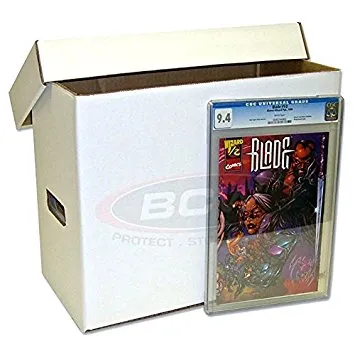
A plastic archival box is the premium option for raw comics. The BCW Archival Book Storage model is the reference product in this category.
Plastic boxes resist moisture, hold up to minor spills, and keep out the dust and pests that cardboard will not. They are heavier, more expensive, and slightly bulkier than cardboard equivalents, but stackable and built to last decades.
Capacity is similar to a cardboard short box, roughly 150 to 175 bagged-and-boarded comics. Use these for higher-value raw keys and any collection stored somewhere that cardboard would not survive.
2. Cardboard Short Box

The cardboard short box is the workhorse of comic storage. It is the box every local comic shop uses, the box on the convention-hall floor, the box under most collectors’ desks.
Short boxes are sized to hold about 150 to 175 bagged-and-boarded modern comics standing upright. The typical dimensions are 15 3/4 by 7 1/2 by 10 3/4 inches. A 200-pound test corrugated cardboard is the standard strength; anything lighter sags under a full load.
Use short boxes for collections you actually read, move, or re-catalog. They are cheap enough to buy in volume, light enough to carry up stairs, and uniform enough to stack four or five high without issue.
3. Cardboard Long Box
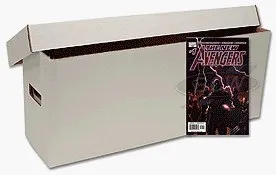
The cardboard long box holds roughly 300 bagged-and-boarded comics, roughly double a short box. Dimensions are around 28 1/2 by 8 1/4 by 11 1/2 inches.
Long boxes are best for bulk storage: runs, back issues, and material you do not plan to dig through weekly. They get heavy fast when full, which is why most people stop using them the first time they try to carry one up a staircase.
If you have a run of a single title that extends past 150 issues, a long box is the clean way to keep them together. If you are building a deep-storage archive in a closet or shelf where you only visit it once or twice a year, long boxes are the right choice.
4. CGC Slab Box
Professionally graded comics ship in a rigid plastic slab (CGC, CBCS, or EGS) that does not fit in any of the boxes above. Slab boxes are dimensioned specifically for the slab footprint and typically hold 25 to 30 graded comics upright, with internal dividers to keep them from sliding.
A CGC slab box is a purchase you only think about when you start grading books. Before that point, a well-organized raw collection does not need one. After that point, they are the only practical way to store a graded collection at scale, and handling a slab collection without them turns into a logistical mess fast.
5. Generic Plastic Bin
The fifth category is the catch-all: generic, non-comic-specific plastic bins. A commercial tote from a hardware store, a lidded storage bin, a heavy-duty plastic drawer. These are cheaper than purpose-built plastic archival boxes but lose the internal proportions that keep comics standing upright.
Generic bins are useful in two situations. First, when a collection lives somewhere genuinely risky (a garage, a flood-prone basement, a humid storage unit) and the priority is keeping water out more than keeping the books organized. Second, when the collection is a pile of low-value reading copies that deserve basic protection but not a premium storage investment.
For anything valuable, a purpose-built box is worth the extra cost. Comics stored loose inside a bin without standing support will lean, bow, and develop spine stress over time.
Decision Framework
The quick read on which box fits which collection:
- Short cardboard: default for any raw collection kept in a climate-controlled room.
- Long cardboard: deep storage for runs and back issues you do not touch often.
- Plastic archival: high-value raw books, or any collection that lives in a less-than-ideal environment.
- CGC slab: graded comics, once you have enough to need a dedicated container.
- Generic plastic bin: reading copies in a risky environment, or a temporary holding tank during a move.
Most collections end up using two or three of these in combination: short cardboard for the active collection, long cardboard for bulk runs, and either plastic archival or slab boxes for the books that matter most.
Comic Dimensions Worth Knowing
When you are shopping for boxes, the dimensions on the packaging are sized for modern comics. Silver Age and Golden Age books are slightly larger and do not always fit cleanly in a modern-size box.
- Modern (1980s to present): approximately 6 7/8 by 10 1/2 inches
- Silver Age (1950s to 1980s): approximately 7 1/8 by 10 1/2 inches
- Golden Age (pre-1950s): approximately 7 3/4 by 10 1/2 inches
Most short and long cardboard boxes handle modern and Silver Age fine. Golden Age books often need oversized “magazine” or “Golden Age” boxes sized for the larger page dimensions. BCW and other manufacturers sell both sizes, so if your collection includes Golden Age material, check the box dimensions before buying in bulk.
The Honest Bottom Line
The single biggest determinant of how well your collection ages is the room it lives in, not the box. Cool, dry, and out of direct sunlight is worth more than any combination of archival box and mylar bag if the room is wrong.
Once the room is right, the box matters at the margins. A cardboard short box and a plastic archival box both do the job; one is cheaper, the other lasts longer. A long box trades portability for capacity. A slab box is required for graded comics and pointless for anything else.
Start with short cardboard boxes for the active collection, upgrade to plastic archival for the handful of books you actually care about most, and add slab boxes as the graded collection grows. That progression covers ninety percent of what any collector actually needs.