Who is Youngblood
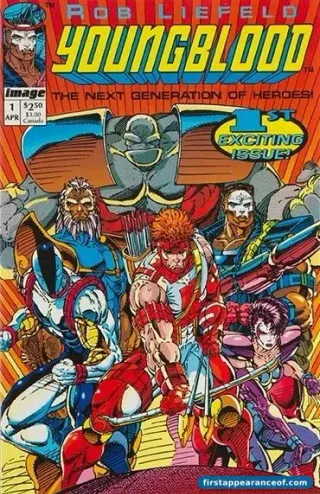
Rob Liefeld pitched Youngblood to Marvel in 1991 as a New Mutants spinoff. Marvel passed. Liefeld rebuilt the concept, kept his characters, and launched Youngblood through Image Comics in April 1992. The book sold approximately 1 million copies of its first issue, which was the highest debut sales of any indie comic at the time and remains one of the highest-selling Image launches in publisher history.
The premise is celebrity-superhero satire by intention and Image-extreme action by execution. Youngblood is a US-government-sanctioned superhero team operating in two divisions: an “Away” team that does public-facing celebrity-superhero work, and a covert “Home” team that does black-ops. The dual-team structure is one of Liefeld’s more interesting choices and is the part of the original concept that has held up best across decades of reframing.
The founding lineup is Shaft (Jeff Terrell, the team leader, an archer with energy arrows), Chapel (Bruce Stinson, the gunman whose other fictional resume includes killing Al Simmons in the Spawn line), Diehard (an immortal cybernetic soldier), Vogue (a Russian-defector codenamer), Combat (a tactician), and Riptide (a water manipulator). The Home team rotates and is the harder roster to track across issues; Liefeld wrote them with less consistency than the Away team.
The book has aged unevenly. Liefeld’s art in 1992 is the iconic Image-extreme style: anatomical exaggeration, oversized weapons, gritted teeth, no feet visible in any panel. The visuals defined a generation of superhero comics and are also why most modern critics treat Youngblood as a curiosity rather than a continuing creative property. Liefeld’s writing is functional and rarely deeper than the framing suggests; the satirical celebrity-superhero premise that the book points at is mostly underdeveloped in the 1992 Liefeld text.
Joe Casey’s 2008 relaunch is the version of Youngblood that most readers familiar with both eras will recommend. Casey took the original premise and actually wrote the celebrity-superhero satire, with Derec Donovan handling art in a cleaner style than the Liefeld original. The 2008 run is the most-respected creative period in the title’s history. Chad Bowers and Jim Towe’s 2017 relaunch is the second-most-respected run; the Bowers-Towe version is more action-forward than Casey’s but retains coherent character work.
Why the launch matters
Youngblood #1 was the test case for the Image Comics business model. The seven founding partners had left Marvel together in 1991 to form a publisher where they would own their characters and control their books. The publisher launched in 1992 with multiple simultaneous title debuts. The question across the comics industry was whether creator-owned superhero comics could sell at the same level as Marvel and DC properties. Youngblood #1’s 1 million-copy sale answered that question on the affirmative, which made the rest of the Image lineup commercially viable and influenced the entire 1990s superhero publishing landscape.
The book’s commercial success and its qualitative limitations are both part of its historical weight. Youngblood is the book that proved creator-owned superhero comics could sell. It is also the book that demonstrated how badly 1990s extreme-superhero aesthetics aged. The two facts coexist; collectors and critics generally agree on both even when they disagree about everything else regarding the title.
The Awesome / Maximage interlude
Liefeld left Image Comics in 1994 over partner-level disputes and took Youngblood with him. The character relaunched under his Maximage imprint in 1995 and continued through Awesome Comics in the late 1990s. The Awesome era is the messiest period in Youngblood’s publishing history; multiple relaunches, inconsistent creative teams, and an Alan Moore-written run in 1998 (Judgment Day, Supreme, and adjacent Awesome titles) that gave Liefeld’s properties a serious literary treatment Liefeld himself had never been able to produce. The Moore-Awesome material is widely considered some of the strongest work ever published using Liefeld characters; Awesome Comics collapsed before the Moore work could be fully developed, and the rights to most Awesome-era Youngblood material remain tangled.
Youngblood returned to Image Comics in the 2000s and has been published intermittently from there since. The current rights situation is that Liefeld controls Youngblood and licenses the title to Image for ongoing publication; new Youngblood material continues to appear sporadically.
Live action and adaptation
A Youngblood live-action film has been in development since 2008. Multiple producers and studios have attached themselves to the project across the past two decades; none has progressed to production. Liefeld is publicly involved in the development discussions. The closest the project has come to a green light was a 2018 Brad Wyman / Akiva Goldsman attachment that did not advance.
The character Prophet (a Liefeld creation that briefly intersected with Youngblood in the 1990s) had a successful 2012 Image relaunch under Brandon Graham that is generally considered one of the strongest things ever done with a Liefeld property. Prophet is not technically Youngblood but shares a publishing history.
Collector context
Youngblood #1 (1992) trades modestly. Print runs were enormous; supply remains plentiful; CGC 9.8 trades in the low to mid three figures depending on cover variant. The book had a gold-foil first-print that trades higher than the standard cover. Youngblood-line books from 1992 to 1994 (Brigade, Bloodstrike, Team Youngblood) are similarly priced as historical artifacts of the early Image era rather than as high-value collectibles.
The most-tracked Youngblood book by collector premium is the Liefeld-signed first print. Youngblood #1 in CGC 9.8 with a Liefeld signature has traded above $1,000 at auction; the unsigned version trades around $300 in the same grade. Premium-edition variants from the late 1990s Awesome period are obscure and trade as Awesome-Comics-specific rarities rather than as Image-line keys.