Who are the G.I. Joe Team
Licensed comics are supposed to be disposable. Hasbro hired Marvel in 1982 to sell action figures, and the expected output was a house-style adventure book that would run as long as the toy aisle held out. What Hasbro got instead was a writer who treated the assignment as a military brief.
Larry Hama had pitched a spy series called Fury Force that went nowhere. When editor-in-chief Jim Shooter connected Hasbro to Marvel, Hama adapted that idea into G.I. Joe and then did the thing that made the difference: he wrote the file cards. For roughly the first ten years, the biography printed on the back of each figure’s packaging came from the man writing the comic, drawing on his own military service. Every Joe arrived with a service record, a specialty and a real name before a reader met him on the page.
Hama gave the Bronze Age licensing experiment a memory. The cartoon, the films and three subsequent publishers have all reached back to his continuity because it was the only version of G.I. Joe anyone had written down properly. The toy line finished in 1994. Hama’s comic was still running four decades after it began.
How toy-first debuts are dated
G.I. Joe breaks the assumption most of this site runs on. For a character created in comics, the comic is where the character begins, so “first appearance” needs no qualifier. For a Hasbro property, the figure and its file card usually exist first and the comic is the adaptation.
On FAO, “first appearance” means a comic book. The listed, priced and photographed debut is the issue because it carries a cover date, print run and grade. A documented earlier toy release gets its own row on the Firsts Timeline, labelled by medium and placed above the comic. Member pages name whichever dated debut came first without blurring a figure release into a comic key.
It cuts the other way often enough to matter. Storm Shadow was Hama’s invention for the comic and became a figure afterwards, so his page carries the comic row and nothing above it. The rule is applied character by character, never as a blanket claim about the property.
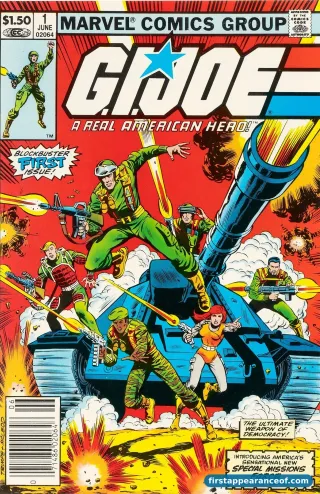
At team level the same test gives a clean answer. Hasbro printed G.I. Joe comics long before Marvel: a giveaway packed with figures in 1967, then in-house Adventure Team books through the 1970s. None of them contain the Joes, Cobra or any of this continuity. A Real American Hero #1 is where the team as it is now understood first appears.
The comic Hasbro advertised on television
The launch produced one genuinely strange piece of marketing history. Television rules limited how toys could be advertised, and a comic book was easier to promote than the plastic it was selling, so Hasbro bought airtime for the comic instead of the figures. The ads sold a Marvel title; the figures rode along behind it.
The series is commonly cited as the first comic book advertised on television, though that claim comes from later media scholarship rather than publisher records. The documented part is stranger: Hasbro used the comic as the television commercial for its toys.
Silent Interlude
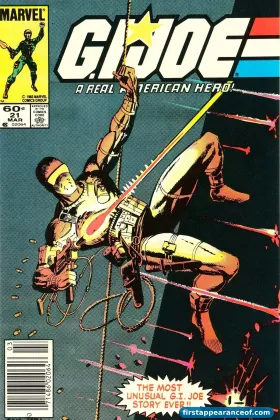
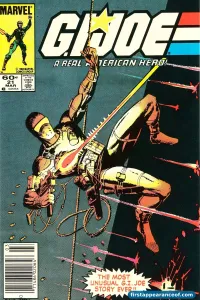
Issue #21, cover-dated March 1984, is the one that gets reprinted. Hama wrote and laid out a full-length Snake Eyes rescue with no dialogue and no sound effects, and Steve Leialoha finished it. It ran as a regular monthly issue of a licensed toy comic.
It also carries the first appearance of Storm Shadow, which is how a silent experiment became the issue people chase after the debut.
Four publishers and one writer
Marvel’s run ended with issue #155 in December 1994, the same year the toy line closed. What followed is the messiest part of the property’s history, and the part most likely to be out of date in older write-ups.
Devil’s Due picked the license up in July 2001, first through Image, then on its own, and lost it in 2008. IDW took over that year, revived Hama’s numbering in 2010 by resuming at #155½, and carried the flagship title to #300 in December 2022 before the license moved again. Hasbro announced Skybound, an Image imprint, as the new holder in June 2023; Hama returned with #301 that November, and Skybound folded the Joes into a shared universe with the Transformers. Skybound is the current publisher.
Four publishers and four decades on, the continuity everyone keeps returning to is the one Hama wrote, and he is the one writing it again.
Notable issues
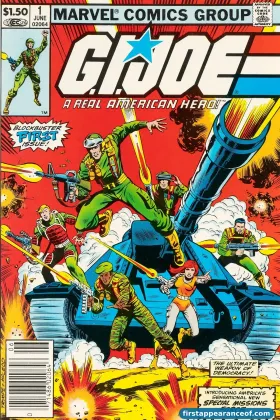
- G.I. Joe: A Real American Hero #1 (1982): first appearance of the team. Larry Hama, Herb Trimpe and Bob McLeod.
- G.I. Joe: A Real American Hero #21 (1984): Silent Interlude. First appearance of Storm Shadow, and the run’s calling card.
- G.I. Joe: A Real American Hero #155 (1994): the last issue of the original Marvel run.
- G.I. Joe: A Real American Hero #155½ (2010): IDW restarts Hama’s numbering sixteen years on.
- G.I. Joe: A Real American Hero #300 (2022): the end of the IDW license.
- G.I. Joe: A Real American Hero #301 (2023): Hama resumes the series at Skybound.
For collectors
Two books carry the run. Issue #1 is the debut; plentiful copies push collector interest toward high grade. Issue #21 is the connoisseur’s pick, combining Storm Shadow’s first appearance with the story people cite when they argue that a licensed comic can be art.
The rest of the run is a reader’s market. Most issues turn up cheaply and in decent shape, which makes this one of the friendlier 1980s runs to complete. Collectors chase the two keys in grade; the rest of the run reads cheaply.