Creation Story
Judge Dredd is the flagship character of British weekly comic 2000 AD, which launched in February 1977. John Wagner and Carlos Ezquerra co-created the character during the magazine’s development; Pat Mills edited the launch. The character was pitched alongside other 2000 AD features (Dan Dare, MACH 1) and was intended as one of several rotating strips rather than the flagship he became.
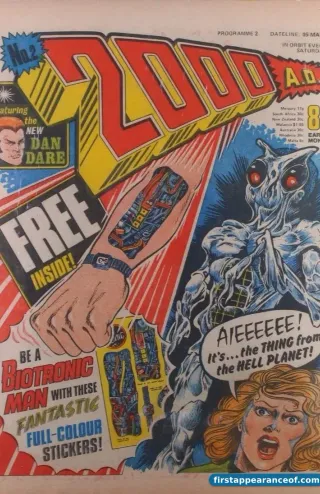
2000 AD Prog #1 (February 26, 1977) launched the magazine but did not contain Dredd. 2000 AD Prog #2 (March 5, 1977) is Dredd’s first appearance: a six-page strip inside the weekly, not on the cover. Ezquerra designed the visual character: the helmet, the eagle shoulder-pad, the Lawgiver sidearm, the Lawmaster motorcycle. The design has been essentially unchanged across five decades.
Wagner has been the primary Dredd writer across the character’s entire history. He wrote the debut and remains a regular contributor to the 2000 AD weekly and the companion Judge Dredd Megazine (launched 1990). His forty-eight-year continuous writing tenure on a single character is one of the longest in any medium of serialized fiction.
The satirical framework
Dredd is structurally satirical. Wagner and Mills designed Mega-City One as a critique of authoritarian policing: the Judges combine police, judge, and executioner in a single institution, and Dredd himself is the institution’s most effective operator. The character’s competence does not mean the system he serves is correct; readers are meant to see the system as dystopian and Dredd as complicit.
The satirical framing has been the book’s defining editorial thread. Subsequent arcs across decades have tested Dredd’s commitment to the system (The Apocalypse War, America, Necropolis, Origins) without ever fully redeeming or condemning the character. Wagner has resisted sentimental character-development arcs that would soften Dredd into a conventional hero; the character remains ideologically static by design.
The face rule
Dredd’s face is never shown in the comics. This is a deliberate editorial decision maintained across forty-eight years. Wagner has stated the rule exists because the character is meant to represent the system rather than an individual; a revealed face would personalize him in ways that undermine the satirical framework.
The 1995 Judge Dredd film with Sylvester Stallone violated the rule; Dredd removes his helmet and delivers the “I am the law” catchphrase in civilian context. The film was widely criticized by fans and by Wagner himself. The 2012 Dredd film with Karl Urban preserved the rule: Urban’s face is never shown, and his performance relies entirely on jaw and voice. The 2012 film is the more-respected adaptation and has developed cult status despite underperforming commercially.
Collector context
2000 AD Prog #2 is the Judge Dredd key. High-grade copies trade in the low-to-mid four-figure range; CGC certification is available but uncommon for British weeklies. 2000 AD Prog #1 (the magazine launch, no Dredd) is a parallel collector target for 2000 AD completists.
Secondary keys: 2000 AD Prog #9 (first Dredd cover). 2000 AD Prog #61 (Cursed Earth arc start). 2000 AD Prog #245 (Apocalypse War start). Judge Dredd Megazine #1 (1990, companion magazine launch).